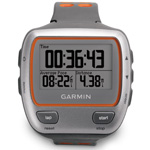
Poolrunning works so much better when you have the toys to support it. Here's what I use:
Training Watch:
I use the Garmin 310xt. It's my normal GPS / HR monitor training watch that I use when running outside, but with a few extras that also make it very well suited to poolrunning. For one thing, it's water proof, which is obviously key.
For workouts, you can program it to provide you "alerts", by either vibration or tone, at set points (by distance or by time). I use this function a lot in the pool. For my "interval workout", I program the Garmin for "10x3:00 interval/1:00 rest" -- essentially 10 intervals of 3 minutes each, with 1 minute rest. The Garmin vibrates on my wrist at the end of each 3 minute interval, and vibrates again at the end of the 1 minute rest to cue me to the next interval. Thus, I can skip staring at the pool timer as I do my workout (and also can still do a workout by time if I'm at a pool with no timer). The Garmin also counts down the reps left in the workout, which is very nice (it's surprisingly easy to lose track when you're pushing very hard).
Some people complain that the Garmin is too big, but I've never had any discomfort from it, and my wrists are tiny by almost anyone's standards. The one hitch is that the Garmin's heartrate monitor does not function underwater; to do HR training, one apparently needs to invest in a Polar HR monitor.
Music:
I use an iPod Nano, in an H20 Audio ipod case. When you're cranking out a lot of hours in the pool, having something to entertain you is key. The nice thing about this case, as compared to others, is that it allows you to control the iPod while it is in the case (as opposed to others I've seen or borrowed, where you need to start the iPod prior to placement in the case, and are unable to change anything once it's in the case).
Depending on your bathing suit, you may need to have an aquabelt in order to use this case. The case has a clip, but a woman's one piece bathing suit lacks a good place for the case to clip onto, requiring the use of a belt in order to have something to clip the case to. (men's swimming trunks or a female two piece won't have this same issue). I also note that the case doesn't float, and so if it does become unclipped, it may very well fall to the bottom of the pool. I work around this by looping a shoelace through the clip, and then through my aquabelt, as a safety of sorts.
Aqua jogging belt:
There are people who run with the belt, and people who run without. There are people who swear that you can't get a good workout unless you run without the belt, and people who swear that they need the belt.
For myself, after a lot of work, I've developed the ability to poolrun without the belt, but have also noted that I don't seem to get a good workout without the belt -- I focus on staying afloat, rather than on actually pushing the workout. So, I run with the belt.
Most pools have belts for use. I pool-run at several different pools, and so have test-driven several different belts. I've developed a preference for the Kiefer belt. It's smaller than other models, and so less encumbering. It's also pretty soft, with a stretch belt, that makes it much more comfortable than other belts. The only thing I can't speak to is its durability.
Aquajogging shoes:
I don't have these yet, but I want them. Supposedly they increase the water's resistance, adding to your workout. For me, the clear benefit would be in increasing the resistance as you push against the water with your foot, making the pool running slightly closer to real running. I do note that many pools have signs banning these, though I don't know how strictly that ban is enforced.
The AQX model seems to be the model of choice, though it is also sadly discontinued.
A "journey" involving running in place in the deep end, and now starring a runner with Parkinsons. Quite possibly I've gone off the deep end.
Tuesday, December 28, 2010
Sunday, December 26, 2010
Training - week ending 12/26/2010
End of week 7, post fracture. This week was 86 “miles” pool running (per my conversion below) plus 3.5 hours on the arc-trainer. -- training log is here.
Wow. Shocking news. My foot is apparently healed and I am cleared for running – 5 weeks ahead of schedule. I don’t feel ready to run yet – I *just* got out of the aircast, and my left leg is still pretty weak. I don’t think it makes sense to go directly from 6 weeks of immobilization and zilch weightbearing activity to running, so I’m going to do another week or two of power walking, arc-trainer work, and lower leg strengthening. And then I’ll start some test run/walk combos, possibly as early as this Wednesday.
Dailies
Monday: In the morning, “13.5 miles” – 2 hours pool running, including an “800s” workout of 10x3:00 at hard effort, with 1:00 recovery (went for 4:00 straight for the last), followed by full recovery and then 25 minutes at aerobic effort. In the evening, 30 minutes on the arc-trainer.
Tuesday: In the morning, “10 miles” – 1:40 hours easy pool-running, plus strength training. In the evening, another “5 miles” – 50 minutes easy pool-running.
Wednesday: In the morning, 30 minutes on the arc-trainer plus 1:45 hours easy pool running for “10.5 miles”. Pilates at night.
Thursday: “19 miles” - 2:45 hours pool running in the morning (started by alternating 10 minutes easy/5 minutes at aerobic pace, and then ended with 25 minutes at aerobic-tempo effort. At night, 45 minutes on the arc-trainer.
Friday: “12 miles” – 2 hours pool running plus a yoga class.
Saturday: “4 miles” – 40 minutes easy pool running, plus 1:45 hours on the arc-trainer at moderate effort, plus upper body weights. I skipped my scheduled tempo pool-run for this morning in favor of a long arc-trainer workout, to see how my foot/leg handled a lengthy weight-bearing workout.
Sunday: “12 miles” – 2 hours easy pool running.
Wednesday, December 22, 2010
Well, THAT was a surprise...
I had my 7 week follow-up visit with the podiatrist this morning. Visits to the doctor when you're injured are a bit like visits to the Oracle. You traverse a perilous and stressful journey (through DC traffic), make an offering (Visa copay of $30), present your question, and then wait for the Oracle's pronouncement, which is grounded in the interpretation of things beyond your ken (x-rays).
In my case, the good doctor first palpated my foot and wiggled my toes (no pain anywhere, at all) and asked me how it felt when I walked or ellipticalled (no pain at all, just a lot of stiffness, especially during the toe-off phase of walking). So, very good. He sent me to the next room to get the foot x-rayed for the third time in this saga.
Then I waited, and waited. And stared at a shiny poster depicting all the things that could go wrong with my feet. And played with my phone, stunned at the lack of reception despite being in a fifth floor room with a window on K street in downtown DC.
I was debating whether to break down and actually read a pamphlet about bunions when he strode back in (I don't think I waited much at all after the x-ray, it just seemed like an eternity).
"This looks really good."
Huh? I had braced for the opposite.
He pulled up the x-ray on his laptop, and the improvement was clear, even to me. The fracture was completely gone; in its place was a perfectly formed bone with a fuzzy halo around the site of the fracture. He explained to me that what he saw was a repaired bone, with a fully formed "boney callus" around it.
To explain further, my (non-medically trained) understanding is that bone healing has several stages:
After giving me a brief tour of my own metatarsal, he looked at me.
"If we really wanted to play it super-safe, we'd wait until the beginning of the year to start running on it. But this looks really solid. I think if you want, you can start running on it now. Just be very careful - I only want you running every other day for the first few weeks, and I don't want your running to total more than a mile a day for the first week; 2 miles a day for the second week.
"It's going to be a bit stiff and achy, and that's normal -- you've got all sorts of soft-tissue adhesions that are going to break apart as part of the process. Just keep an eye on it. If you feel any real pain, back off for 2-3 days. If it starts hurting, and doesn't feel better after 3-4 days of no running, give me a call and we'll discuss whether you need to come back in. But right now I don't think I need to see you again unless something changes."
I was shocked. I had hoped as a best case scenario that he'd tell me to come back in 3-4 weeks for another set of x-rays, and an evaluation of whether I could start running again. As funny as it sounds, I'm not sure I'm ready to run just yet.
Truth be told, I may have a bit of injury/poolrunning Stockholm syndrome. I've come to see myself as an injured princess runner in my deep water fortress, safe from worrying about time splits or the reality of crappy running days. I've grown spoiled. I'm now used to the constant affirmations of how wonderful it is that I'm trying to stay active while injured, the constant compliments on my avid poolrunning, and the people who open doors or carry bags for me. The pool is windfree and warm, while ice and chill lurk outside. And now I have no excuse not to shovel snow.
Additionally, aside from any mental issues, while the bone may be ready for running, I'm not sure the leg is. Six weeks of immobilization have left the foot and lower leg very weak, and my range of motion in the left ankle is much less than the right. It improves every day as I walk -- I hobbled the first day or two, but now walk almost normally. But I fear that if I begin to run right now, while this bone will hold, something else somewhere will give.
So I asked the doctor if I could delay running another week or two. This isn't as odd a question as it first sounds. During our last visit, he had been very clear that it wasn't that I could take the aircast off and start the elliptical at the 6 week mark, but that I needed to, and that he wanted to see me after I had been walking and ellipticalling and stressing it.
In this case, though, he told me I was fine and even smart to take it slower. I told him that I wanted to spend more time walking and using the elliptical, and just bringing that leg up to the same range of motion and strength as the right, before I began to run, and he agreed with the idea.
So, that's my plan for right now (unless coach objects). The next week or two will be dedicated to ever increasing elliptical and walking (I'd like to get up to "power walking" for at least an hour), plus foot strengthening and range of motion exercises, before gently starting to run (starting by going to the track and jogging the straightaways and walking the turns).
I'm registered for the National Half Marathon in late March (I registered this past July, to take advantage of the discounted fee) and the Cherry Blossom 10 Miler in early April, but I am operating under the assumption that I won't be running either. Maybe I can race the 5K associated with Cherry Blossom, and maybe I'll be able to head up to Philly take a crack at the Broad Street 10 Miler in early May. But it's still way too early to hope, and the priority remains on getting totally healthy.
As for how I managed to cut 12 weeks healing time down to 7? Doctor pointed out that I was a) very compliant and b) very aggressive in treating this. A few examples:
In my case, the good doctor first palpated my foot and wiggled my toes (no pain anywhere, at all) and asked me how it felt when I walked or ellipticalled (no pain at all, just a lot of stiffness, especially during the toe-off phase of walking). So, very good. He sent me to the next room to get the foot x-rayed for the third time in this saga.
Then I waited, and waited. And stared at a shiny poster depicting all the things that could go wrong with my feet. And played with my phone, stunned at the lack of reception despite being in a fifth floor room with a window on K street in downtown DC.
I was debating whether to break down and actually read a pamphlet about bunions when he strode back in (I don't think I waited much at all after the x-ray, it just seemed like an eternity).
"This looks really good."
Huh? I had braced for the opposite.
He pulled up the x-ray on his laptop, and the improvement was clear, even to me. The fracture was completely gone; in its place was a perfectly formed bone with a fuzzy halo around the site of the fracture. He explained to me that what he saw was a repaired bone, with a fully formed "boney callus" around it.
To explain further, my (non-medically trained) understanding is that bone healing has several stages:
- the reactive stage: the initial inflammation and clotting;
- the reparative stage: formation of a soft "callus" made of cartilage around the injury site that brings the bone together; followed by conversion of the soft callus into bone -- the "boney callus".
- the remodeling stage: the bone's all there, the body just needs to fine tune it and carry away the excess (at this point, stress to the bone is helpful, as it provides guidance to the body as to how to remodel the bone).
After giving me a brief tour of my own metatarsal, he looked at me.
"If we really wanted to play it super-safe, we'd wait until the beginning of the year to start running on it. But this looks really solid. I think if you want, you can start running on it now. Just be very careful - I only want you running every other day for the first few weeks, and I don't want your running to total more than a mile a day for the first week; 2 miles a day for the second week.
"It's going to be a bit stiff and achy, and that's normal -- you've got all sorts of soft-tissue adhesions that are going to break apart as part of the process. Just keep an eye on it. If you feel any real pain, back off for 2-3 days. If it starts hurting, and doesn't feel better after 3-4 days of no running, give me a call and we'll discuss whether you need to come back in. But right now I don't think I need to see you again unless something changes."
I was shocked. I had hoped as a best case scenario that he'd tell me to come back in 3-4 weeks for another set of x-rays, and an evaluation of whether I could start running again. As funny as it sounds, I'm not sure I'm ready to run just yet.
Truth be told, I may have a bit of injury/poolrunning Stockholm syndrome. I've come to see myself as an injured princess runner in my deep water fortress, safe from worrying about time splits or the reality of crappy running days. I've grown spoiled. I'm now used to the constant affirmations of how wonderful it is that I'm trying to stay active while injured, the constant compliments on my avid poolrunning, and the people who open doors or carry bags for me. The pool is windfree and warm, while ice and chill lurk outside. And now I have no excuse not to shovel snow.
Additionally, aside from any mental issues, while the bone may be ready for running, I'm not sure the leg is. Six weeks of immobilization have left the foot and lower leg very weak, and my range of motion in the left ankle is much less than the right. It improves every day as I walk -- I hobbled the first day or two, but now walk almost normally. But I fear that if I begin to run right now, while this bone will hold, something else somewhere will give.
So I asked the doctor if I could delay running another week or two. This isn't as odd a question as it first sounds. During our last visit, he had been very clear that it wasn't that I could take the aircast off and start the elliptical at the 6 week mark, but that I needed to, and that he wanted to see me after I had been walking and ellipticalling and stressing it.
In this case, though, he told me I was fine and even smart to take it slower. I told him that I wanted to spend more time walking and using the elliptical, and just bringing that leg up to the same range of motion and strength as the right, before I began to run, and he agreed with the idea.
So, that's my plan for right now (unless coach objects). The next week or two will be dedicated to ever increasing elliptical and walking (I'd like to get up to "power walking" for at least an hour), plus foot strengthening and range of motion exercises, before gently starting to run (starting by going to the track and jogging the straightaways and walking the turns).
I'm registered for the National Half Marathon in late March (I registered this past July, to take advantage of the discounted fee) and the Cherry Blossom 10 Miler in early April, but I am operating under the assumption that I won't be running either. Maybe I can race the 5K associated with Cherry Blossom, and maybe I'll be able to head up to Philly take a crack at the Broad Street 10 Miler in early May. But it's still way too early to hope, and the priority remains on getting totally healthy.
As for how I managed to cut 12 weeks healing time down to 7? Doctor pointed out that I was a) very compliant and b) very aggressive in treating this. A few examples:
- During the initial injury, within about 30 seconds of the foot going "pop", I called it a day, and began icing. The foot didn't hurt at all, and I felt silly at the time, like I was overreacting. But apparently that willingness to shut stuff down ASAP saved this from being much worse than it could have been.
- Once I had the aircast, I stayed in the aircast. I've heard stories of a lot of people "cheating" on it, or trying to cycle or elliptical with it. Nope. It was hard, but I stuck to the pool.
- I'm well aware of my tendencies towards lousy circulation, as well as my Raynauds (fun picture of an attack here). Both indicated a problem with healing, which is so dependent on blood flow. So I addressed these by constantly keeping a heating pad on the foot and hopping in a hot shower anytime the Raynauds hit. I think my heavy regimen of poolrunning also helped a lot here in keeping the blood moving.
- I also made the affirmative decision to accept weightgain during my down time. I calculated early on that I could either a) try to diet to keep from gaining weight during this period of decreased activity, or b) focus on sufficient protein and calcium and calories, and if that meant a few pounds, oh well. I chose B. 7 weeks later, the jeans are tight, the rear jiggles, and the scale is a few pounds up. But I'm cleared to run, and I'm more than happy with that trade-off.
- Finally, the magic machine: the Exogen 4000 Bone Stim. It pulses ultrasound to the bone, promoting healing. My podiatrist wanted me to get one from day 1, due to my circulation problems and Raynauds.
I spent the first week coordinating with the Smith and Nephew rep who was trying to get my insurance (BCBS) to cover it. During this time, I did some research online, and it became pretty clear from BCBS's published coverage memos that they were NOT going to cover it until I had gone 3 months no healing. This was unacceptable. So I went to the medical provider of last resort -- Ebay -- and purchased a slightly used device for ~$350 (about the same as my copay would have been, had BCBS covered it).
The research was based on using it once a day, but my doctor told me to be more aggressive, and so I zapped my foot every 8 hours (5 am, 1 pm, 9 pm) with religious zeal. Did it work? Honestly, no way to tell from this sample size of one. But research (published on S&N's website, and I've also verified independently) indicates a reduction of healing time of up to 38% from consistent use of the bone stim. 38% of the original projection of 12 weeks is ~ 4 and a half weeks less -- which is about where I'm at right now. Hmmmm.
Monday, December 20, 2010
Tempo "runs" in the pool.
When I broke my foot, I knew that I'd be limited to pool running for quite some time to come. My original plan was to do intervals 6 days a week a la Pfitzinger; but when I reached out to my newly-retained coach, he advised that I recreate my training schedule in the pool -- one interval workout, one tempo workout, and one long run each week, with easy "running" for the balance.
OK then. I had the interval workout down, and the long run seemed pretty easier to execute (just stay in the pool longer). But how to do the tempo?
To explain the dilemma, I first need to explain my understanding of what tempo is. In my book, a "tempo" is a run of 20+ minutes at a "comfortably hard pace" -- the classic definition is 20 minutes running at the pace you could hold for about 60 minutes in a race. It's also possible to do longer tempo runs at a slower pace. My general rule of thumb for tempos has been to run at race pace for a third of the race time. For example, I know that I race a half-marathon in a bit over 90 minutes, so I would do a tempo at half-marathon pace for about 30-35 minutes.
The whole point to a tempo is to hold a certain, "comfortably hard" pace for a decent amount of time. Run it too fast, and you're straining the wrong systems and burning yourself out for no good reason; run it too slow, and you're not giving your system enough of a training stimulus. In addition to the physical results of a good tempo, it's also a solid mental training exercise -- you learn how to dial into an effort and sustain it.
All very good, but how the heck do you do that in the pool? The thing about the pool is, there's really only three gears that come naturally -
Thus, the conventional wisdom is that when confined to pool running one should do intervals nearly every day. The reasoning is that it's simply too hard to keep your hard rate elevated for a lengthy period of time, so instead you blast out an interval of 30 seconds to 3 minutes at top effort, take a short break to reassure the lifeguard that you're not actually drowning, and then wash, rinse, repeat.
And yet, I was under instructions to do a tempo each week. My first attempt was three intervals of 10 minutes each, with a minute rest, shooting for that comfortably hard effort. OK, I could do this.
Reported back to the coach, and was corrected. Intervals of 10 minutes at that effort are a "cruise intervals" workout, not a tempo (which I knew, I had just been fudging, since I had no idea where I was going to find the mental strength to do a regular tempo in the water).
Fair enough. So, a tempo it was. But how to do it?
I ended up figuring it out the old fashioned way, by donning first my big girl panties and then my aqua-belt, and giving it a shot. And after a few weeks, I can say now that I am capable of doing a 40 minute tempo "run" in the pool. The tricks to doing this really boil down to two categories: 1) accurately gauging the effort level, and 2) toughing it out for the full length of time. In turn:
Effort level tricks:
OK then. I had the interval workout down, and the long run seemed pretty easier to execute (just stay in the pool longer). But how to do the tempo?
To explain the dilemma, I first need to explain my understanding of what tempo is. In my book, a "tempo" is a run of 20+ minutes at a "comfortably hard pace" -- the classic definition is 20 minutes running at the pace you could hold for about 60 minutes in a race. It's also possible to do longer tempo runs at a slower pace. My general rule of thumb for tempos has been to run at race pace for a third of the race time. For example, I know that I race a half-marathon in a bit over 90 minutes, so I would do a tempo at half-marathon pace for about 30-35 minutes.
The whole point to a tempo is to hold a certain, "comfortably hard" pace for a decent amount of time. Run it too fast, and you're straining the wrong systems and burning yourself out for no good reason; run it too slow, and you're not giving your system enough of a training stimulus. In addition to the physical results of a good tempo, it's also a solid mental training exercise -- you learn how to dial into an effort and sustain it.
All very good, but how the heck do you do that in the pool? The thing about the pool is, there's really only three gears that come naturally -
- a very slow easy motion that really serves mainly to move your legs around;
- "easy" effort -- you keep your body active and moving forward; and
- All out excruciating effort -- send it to 11, Nigel.
Thus, the conventional wisdom is that when confined to pool running one should do intervals nearly every day. The reasoning is that it's simply too hard to keep your hard rate elevated for a lengthy period of time, so instead you blast out an interval of 30 seconds to 3 minutes at top effort, take a short break to reassure the lifeguard that you're not actually drowning, and then wash, rinse, repeat.
And yet, I was under instructions to do a tempo each week. My first attempt was three intervals of 10 minutes each, with a minute rest, shooting for that comfortably hard effort. OK, I could do this.
Reported back to the coach, and was corrected. Intervals of 10 minutes at that effort are a "cruise intervals" workout, not a tempo (which I knew, I had just been fudging, since I had no idea where I was going to find the mental strength to do a regular tempo in the water).
Fair enough. So, a tempo it was. But how to do it?
I ended up figuring it out the old fashioned way, by donning first my big girl panties and then my aqua-belt, and giving it a shot. And after a few weeks, I can say now that I am capable of doing a 40 minute tempo "run" in the pool. The tricks to doing this really boil down to two categories: 1) accurately gauging the effort level, and 2) toughing it out for the full length of time. In turn:
Effort level tricks:
- I like to start the tempo off at interval effort, and then let myself settle slightly after about a minute - for some reason, it's easier to "fall" into tempo effort than it is to "push" into it.
- Breathing really seems to be key here. I've found that about 5 minutes into the tempo, my breathing should hit about one inhale/exhale cycle every three "steps". So, *inhale* (three steps); *exhale* (three steps). This is really a remarkably good way to assess your effort level over time -- a quick breath check can highlight the fact that you're slacking (or perhaps pushing too hard).
- Visualization does help - imagine that you're running a tempo on land, and envision each land mark that you pass, and each mile marker. Yes, you'll get a weird glazed look on your face, but nobody's going to notice.
- When you're running a tempo on land, about 2/3rds of the way through, there's a point where you really start wanting to be done. You're not in pain, you're just physically tired and mentally a bit sick of the whole thing. Getting that feeling during a pool run tempo, about 2/3rds of the way through, is a very good sign.
- Music can help -- program a mix of uptempo stuff, fast paced stuff, and then run to the music. Personally, I find that progressive house, psytrance, or futurepop works well, but we're each unique in what music motivates us.
- Take it minute by minute. You're not doing a 40 minute pool run at tempo effort; you're doing forty intervals of 60 seconds each at tempo effort, with no recovery. This simple change in perspective really does help.
- Believe it or not, pool shape is key here. I've found it helpful to get in a lane, and then do laps of the lane, viewing it as a track of sorts. I normally do my tempos in a ~20 meter lane (it gets too shallow towards one end to do the full 25 meters), and so I know it takes me about 2:30 to do a "lap". Therefore, my 40 minute tempo is actually a 16 lap tempo. I take splits after each lap, and use certain points along the lane as prompts to check my effort level and form. Heck, you can even reverse direction every 5 laps or so.
- Using the pool running tempo as an opportunity to focus on form is also very helpful. For myself, I have a tendency to hunch my shoulders and arch my back when I get tired -- focusing on maintaining the tempo effort while correcting these gives me something to focus on besides the clock.
Sunday, December 19, 2010
Training - week ending 12/19/2010
End of week 6, post fracture. This week was 95 “miles” pool running (per my conversion below) plus 25 minutes on the elliptical -- training log is here. I had an intense training class that lasted from last Friday through this Wednesday, so my online activity was sharply limited for the past week -- hopefully I'll be catching up soon.
As for the foot, when I last saw my podiatrist on the Wednesday before Thanksgiving, he told me that he wanted me to take the aircast off on December 15th, and to try a) walking with a normal shoe, and b) testing the foot on the elliptical. Per his orders, I took the aircast off for good this past Wednesday. Wednesday and Thursday were just practicing walking normally (it’s amazing how much my walking improves each day); on Friday, I started adding in the elliptical and arc-trainer, starting at very light resistance and short duration, and increasing a bit each day.
Over the coming weeks, my plan right now is to gently cut back the pool running mileage slightly (to about 80 “MPW”) while adding in some elliptical and “power walking” as my first steps towards running again. Of course, this all hinges on what the podiatrist says at my next appointment this coming Wednesday.
Dailies
Monday: “15.5 miles” total. In the morning, “11 miles” – 1:35 hours pool running, including an “800s” workout of 10x3:00 at hard effort, with 1:00 recovery (went for 4:00 straight for the last), followed by full recovery and then 20 minutes at aerobic effort. In the evening, 45 minutes easy pool running for 4.5 more “miles”.
Tuesday: In the morning, “12 miles” – 2 hours easy pool-running. Strength training at night (medicine ball tosses – one of my favorites).
Wednesday: “12 miles” in the morning – 2 hours easy pool running. Pilates at night.
Thursday: “13.5 miles” - 2 hours pool running, including a tempo workout of 40 minutes at tempo effort, followed by full recovery, and then eight intervals of 90 seconds hard/60 seconds recovery. Very happy with the effort I sustained for the tempo. Ipod died within the first 30 seconds of the run, so I’m also pretty darn proud that I did the whole 2 hours sans music or company.
Friday: “12 miles” in the morning – 2 hours pool running; in the evening, 5 minutes on the elliptical plus upper body strength training.
Saturday: “18 miles” total in my “long run” – 2:35 hours structured as 10 repeats of 10 minutes easy/5 minutes at tempo effort. This workout is always a solid effort, and leaves me pleasantly tired for the balance of the day. Followed with some leg strengthwork and 5 minutes on the arc-trainer.
Sunday: Upper body strength training in the morning plus 15 minutes on the arc trainer. 2 hours pool running at easy effort for “12 miles” in the afternoon.
Sunday, December 12, 2010
Training - week ending 12/12/2010
End of week 5, post fracture. This week was 84.5 “miles” pool running (per my conversion below) -- training log is here. I have a training class that runs 9-5 each day (including Saturday and Sunday) from this Friday through next Wednesday, and so I was unable to access a pool on Sunday, since none were open before 8:30 or after 6. Thus no pool running that day. Due to the combination of later pool hours+training, I also flip-flopped my long run and my tempo, doing the long run on Thursday.
Aircast is off on Wednesday!
Dailies
Monday: “15.5 miles” total. In the morning, “12 miles” – 1:45 hours pool running, including an “800s” workout of 10x3:00 at hard effort, with 1:00 recovery (went for 4:00 straight for the last), followed by full recovery and then 20 minutes at marathon effort. I felt a bit blah this morning, so kept the intervals slightly easier than I did last week. Strength training at night, plus 35 minutes easy pool running for 3.5 more “miles”.
Tuesday: In the morning, “12 miles” – 2 hours easy pool-running plus lower body strengthwork.
Wednesday: “12 miles” total – In the morning, 90 minutes easy pool running for “9 miles”; in the evening, pilates + 30 minutes easy pool running for “3” more miles.
Thursday: “18.5 miles” - 2:35 hours pool running, including a) including 5 minutes at tempo effort every 10 minutes followed by a 20 minute tempo (trying to simulate a fast finish, as my coach has his runners do during long runs).
Friday: “11.5 miles” total – in the morning, 1:20 hours easy pool running for “8 miles”; in the evening, 35 minutes easy pool running for “3.5 miles”.
Saturday: “15 miles” total – in the morning, “11 miles” - 1:30 hours in the pool, including a tempo workout of 2x20 minutes at tempo effort with 1 minute recovery, followed by 3 minutes at interval effort. Full recovery, and then eight intervals of 90 seconds very hard/60 seconds recovery. In the evening, 40 minutes easy pool running for 4 more miles.
Sunday: No pool running (I had class from 9-5, and no pools were open today at times I could access them). Upper body strength training.
Wednesday, December 8, 2010
Huh?
So, got my annual physical today, from my doctor. She is a) very practical and blunt (which is why I like her); and b) a non-athlete. One of the questions I had on my list to ask her was whether I should get a bone density test done of my feet.
To put this request in context: I have a history of bone density issues stemming back many, many years, and have gotten a scan every 18-24 months to track my progress -- the scan focuses on pelvis, femur, and spine. Over those years, via running and proper nutrition, I've managed to get the bone density of my pelvis and femur OUT of the osteopenic range, and into the normal range (the spine's bone density is trending the other direction, which is why I had added in heavy barbell squats and good mornings to my weekly workouts -- until I broke my foot, anyway).
My last scan was in March of this year, so my doctor asked me what exactly I would gain from having a second one done so soon, especially of a different area. Her point was that even if it read horribly for my feet, she wouldn't recommend medications like Fosamax, given the risks of those drugs and the readings of the previous scan with respect to important stuff like spine, hip, femur.
So, I told her that I was exclusively pool running right now, but at some point was going to return to normal running. I've been operating under the assumption that a large part of my running will be replaced by pool running even after I'm fully healed and back to speed, but knowing what the bone density of my feet is (and whether there's a specific concern there) will help my coach and I decide the proper proportions of pool running versus land, when that time comes.
Her response:
a) well, you broke your foot, so you already know there's an issue.
Can't argue there.
b) why do you have to split pool running and land? Is there really that much difference? Why not just stick to the pool from now on?
I was...flummoxed. I've always struggled with situations where it's clear that someone doesn't get what is just so blindingly obvious, and this was no exception.
How do you explain the difference?
Finally I stammered out something about:
a) I really enjoy competing, and there are no pool-running races. You need to race on land, and thus some proportion of your training DOES need to be running.
b) Pool running can be horrifically boring -- you're not going anywhere or getting outside, just doing little cool blue circles for hours.
c) I hate hate hate chlorine, and the stiff hair, dry skin, and dissolving nail polish that accompanies it.
d) Pool running belts really aggravate my acid reflux.
e) I look decent in a pair of running split shorts, but I have yet to find a flattering bathing suit.
f) I just bought a new pair of Kinvaras in the most awesome colors ever (black and electric blue), and I'm going to cry if I never get to wear them.
[answers C, D, E and F were in my head].
We settled on my getting my next bone scan some time next spring, and getting the feet done at that time.
But still -- how do you answer a question like that? I was stumped.
Tuesday, December 7, 2010
Life in the Aircast caste - some helpful hints
So, just about 5 weeks done in the aircast, with less than 10 days to go. I've learned a lot about living life with this thing, and it's probably worth posting some of it for posterity. Hence, a list of helpful tips:
- Stairs. Since the aircast immobilizes your ankle and foot, there is a trick to going down or up stairs with your aircast.
- To descend stairs:
- rotate your body slightly, so that you are facing about 45 degrees towards your side that does NOT have the aircast on.
- take one step down at a time, leading with the leg that has the Aircast on.
- To ascend stairs:
- rotate your body slightly, so that you are facing about 45 degrees towards your side that DOES have the Aircast on.
- take one step up at a time, leading with the leg that does not have the Aircast on.
- General walking. An aircast adds a non-negligible amount of length to your leg, leading to a leg length discrepancy that can rapidly result in substantial back, hip, groin, and knee pain. I've discovered that a shoe with a 2 inch heel is the closest match.
(as an aside -- I'm going to be a bit sad when I take this off for good and return to my original height of 5'4", instead of the lofty 5'6" to which I have become accustomed).
Even after you even out the discrepancy, your gait will still be off -- the lower leg with the aircast is immobilized, meaning no flexion in the ankle joint, meaning that your knees, hips, and other ankle function in a modified way. You're going to have some pain somewhere, and there's no real solution to this, other than doing what you can to minimize your walking.
- Working out. You now have one of your two legs encased in a device that adds a) 2 pounds in weight to that leg;
b) adds 4 inches in circumference to that calf; 3) makes that leg much less stable to balance on (both because the ankle is frozen and because the bottom of the aircast is designed like one of those silly MBT shoes).
These facts add a bit of difficulty to your gym workout. Obviously, anything that involves standing or balancing on one leg is out (i.e. squats, lunges). My philosophy has always been that free weights are best, but I've learned that there is a place for machines, and that's when you're injured. Some observations on individual exercises:
- For stuff like the abductor/adductor machine, or back raises, you can use a towel behind your good leg to balance things out -- effectively making your calves both the same width.
- For pull-ups, even if you normally do them without assistance, it's better to do them with some sort of machine assistance and just add more reps -- when you hang freely from your hands, the imbalance between your two legs makes you twist in an annoying way.
- IF your injury is in the foot, then you can still do planks and push-ups by removing your aircast and placing the tops of your ankles on a small exercise ball. I imagine you could do the same thing, but on your knees, if your injury is to your lower leg. Of course, make sure that you're stable and strong enough to do this without risk of falling, since you don't have the aircast protecting you.
- TMI. If you're a runner, then your aircast probably means you're in the pool.
Do yourself a favor and invest in some spray Tinactin or something similar. Think about it: a) you're doing an activity in a very moist area; b) if your injury is to the foot, it's probably prohibitively painful to dry your toes thoroughly with a towel; and c) after you fail to dry your feet well, you place them into the same thing (the aircast) that you've been wearing for days now. I assure you, you'll thank me for this tip.
- Warm feet. Toes stick out of your aircast -- it's totally fine to wear a sock on the foot in the aircast to keep it warmer.
- Clean feet. If you're spending time in dusty/sandy places, it makes sense to get a plastic grocery bag to wear over the aircast (looping the top velcro strap through the bag handles). Yes you look stupid, but it's better than getting sand in the damn thing that you've got to wear constantly for the next few weeks.
- Arch support. Talk to your doctor to confirm, but in many cases, you can buy an arch support and place it in the aircast --your plantar fascia will thank you for this.
- Accessories. Your aircast comes with a pump to inflate it (after you've put it on) and deflate it (before you remove it). You need this pump (called a "bulb"), and you will likely lose it. Here's where you buy a replacement bulb. For that matter, you can also buy a replacement liner for your aircast there. Heck, you can even buy a replacement aircast, if things go really south.
- Perspective. Your life will be a lot happier if you learn to see your aircast NOT as something that keeps you from your normal life, but rather as something that enables you to live as much of your normal life while still protecting your healing limb.
Sunday, December 5, 2010
Training - week ending 12/05/2010
End of week 4, post fracture. This week was 95 “miles” pool running (per my conversion below) -- training log is here. Next week and the week after will be a bit lighter, as I’m taking an intensive 6 day training course from Friday-Wednesday.
One positive to report: my resting HR has stayed around 45, just slightly above what it was when I was at my fittest while running, even though I haven't done anything aerobic except poolrunning in over a month. That's a nice bit of validation for the poolrunning.
Dailies
Monday: “15 miles” total. In the morning, “11.5 miles” – 1:40 hours pool running, including an “800s” workout of 10x3:00 at very hard effort, with 1:00 recovery, followed by full recovery and then 15 minutes at aerobic effort.. Strength training at night, plus 35 minutes easy pool running for 3.5 more “miles”.
Tuesday: In the morning, “12 miles” – 2 hours mostly easy pool-running plus lower body strengthwork. (I also threw in 30 minutes of 90 sec hard/60 sec easy, but after being corrected by my coach later that day, I won’t be doing that again.:)
Wednesday: “12.5 miles” total – In the morning, 75 minutes easy pool running for “7.5 miles” plus upper body weights; in the evening, 50 minutes easy pool running for “5” more miles.
Thursday: “13.5 miles” - 2 hours pool running, including a 40 minute tempo. Pilates session in the evening
Friday: “12 miles” – 2 hours easy pool running
Saturday: “19 mile long run” – 2:45 hours in the pool, including 5 minutes at “marathon/half-marathon” effort every 10 minutes; followed with strength training.
Sunday: “11 miles” - 1:50 hours easy pool running.
Thursday, December 2, 2010
Worlds Colliding (running nerd v. infosec geek)
So, about a month ago, I went to the race expo for the Marine Corps Marathon. I had already decided not to run the 10K, since I was still getting over a cold/flu thing, but I wanted to grab my goody bag anyway.
[For non-runners: a goody bag is a bag that you get at many races that contains free samples, coupons, race advertisements, and similar. Stuff like cliff bars, lipbalm, etc. A few things find a second life as cat toys.]
[And, for those of you keeping score at home, this was the same expo where General Electric tested my foot with a fancy machine and declared my bone density to be excellent. This was also 4 days before my foot went pop. And now I've made this post tangentially relevant to the subject matter of my blog. So there.]
In my MCM goody bag, a gift card caught my eye -- it was for $500 in sunglasses from Red Star Eyewear -- a sunglasses manufacturer I'd never heard of. I typed the website address into Google in Firefox, and the search results confirmed that the site was likely safe, so I visited it. Digging through it, it looked like the terms of the deal were that you might get a free pair or two of sunglasses (of dubious quality), but that you paid a decent amount in shipping and handling. So not a full out scam, but definitely a bad deal -- on a par with those old Columbia House Record memberships (apparently Red Star tries to trick you into committing to some sort of "sunglasses club" too).
Brian and I laughed, and I tossed it. But it got me thinking. Race participants are really a huge, untapped market for scammers.
[I do realize that there's an opportunity here to take a shot at the Competitor Group, or Devine Racing. I leave that to y'all]
Just think about it -- we get our goody bags, and act under the assumption that everything in there is somehow vetted and approved by the race management. And it's very easy to get access to those goody bags -- at most of the bigger races, my understanding is that those bags are stuffed by volunteers. Paid race staff are limited to the harder, more specialized tasks -- pretty much anyone can stuff and hand out a bag, and so anyone does.
So here's how you do it:
A) set up a website for some product, including a way to take credit card info;
B) go to a printer, and print a set of fancy fliers promoting your site/product;
C) volunteer for a major marathon or other race, and get yourself a slot filling/distributing goody bags, or even better, manage to get a box of your fliers mixed in with all the other stuff to be stuffed by volunteers;
D) ????
E) Profit!!!!!!
A bit concerning, don't you think? I can't believe this hasn't happened yet, now that I think about it.
Subscribe to:
Posts (Atom)