Showing posts with label non-pool-running cross-training. Show all posts

Monday, November 11, 2019

Training log - Week ending 11/10/19

This week was 23 miles of running, 6 "miles" of pool-running, 500 yards of swimming, 2 hours on the elliptical or arc-trainer, and a whole lotta x-rays and shoulder rehab work -- training log is here.

On Wednesday morning, 3.5 miles into my planned 5 mile run (the last before leaving for Indy), I was hit by a pick-up truck while in a crosswalk.

I'm a planner.  And this was not the plan. 

Amazingly (if I do say so myself), I literally got up and walked away with non-life threatening injuries, though my entire left side was battered with my left shoulder taking the worst of it.  But it very quickly became obvious (if hard to accept) that there was no way I could realistically race the CNO Financial Indianapolis Monumental Marathon on Saturday.  Y'know - the superfast course with fast weather and a 2:55 pace group where I was a member of the elite field.  That one.

[goddammit]

As frustrating as it was, I was also frankly so relieved to be alive that the marathon no longer seemed that big a deal.  And all the x-rays so far (and I've had many) show no indication of broken bones.

But what I did end up with, in addition to a lovely assortment of lacerations and bruises, was a left arm that wasn't working well.  I could use the hand (good) but moving at the shoulder, including lifting my hand above my waist to the front or side, was absolutely impossible.  I just couldn't make the arm move at the shoulder joint on its own - it wouldn't listen to me - and having someone else move my arm was pretty damn painful.

[I should note here, that though I'm ambidextrous, my left arm is normally my stronger, slightly more dominant arm, making its sudden lack of function even more awkward.]

Needless to say, the latter part of the week did not go according to schedule.  Rather than tapering down and hopping on a plane to Indianapolis, I was rehabbing, with my wonderful partner putting his schedule on hold to chauffeur me to various appointments (I couldn't drive the first few days).  Rather than carb-loading, I was protein-loading, trying to give my body as much building material as possible.

And while there was a tiny part of me that wanted to crawl in a hole and cry, there was a much larger part that wanted to take a shot at a marathon to express my fitness, if I could pull it off.  And by "pulling it off" I mean have a decent shot at running a fast time while also being comfortable I wouldn't be making the shoulder any worse or risking anything else.   Marathon running as emotional coping strategy.  And Richmond Marathon, on 11/15, was still open.

So that was the challenge.  While protecting and rehabbing the shoulder, I also had to figure out how to do just enough aerobically to preserve my ability to race Richmond if the shoulder would allow.  I'm unfortunately not one of those people who can shut things down completely during taper - I get stiff and flat.   And my normal cross-training alternatives of swimming and pool-running were out.  (I could _kinda_ pool-run, but only by wearing a belt and crossing my arms). 

So...after consulting with a physical therapist friend, and getting fully checked out by multiple doctors, I turned to the arc-trainer and the elliptical.  To protect my shoulder, I either clasped my hands in a fist and held them at my chest or placed them on stationary handles.

At the same time, I was working on the shoulder - starting by walking in a shallow water pool (the water supported the weight of my left arm) while using my right hand/arm to grasp the left arm and move it around.  From there, I moved to exercises on land - I placed my left hand on my kitchen island, and let my fingers walk the arm out and back in.  Plus lots of icing to bring down the swelling (because of my ulcerative colitis, I can't take NSAIDS).

All very humbling - a week ago I was doing presses with 35 pound dumbbells.  And now, I can't envision doing a pressing motion with my unweighted hand.  But, you have to train where you are, not where you wish you were or used to be.

Over a few days of careful rehab, I got to the point where I was comfortable trying to run.  I have a fairly low arm swing, so I don't need that much range of motion or strength in the arm to run.  Test runs on Saturday and Sunday went well - good enough to build confidence that Richmond would happen if the doctor signed off.  [I will NOT race Richmond if there is a possibility that it will make anything worse or create a new injury.]

So that was the good news.  Unfortunately, independent of the arm, I didn't feel great on Sunday - just stiff, sluggish, flat.  But I think this is not that surprising.  I've had to cut out a LOT of my daily routine - I can't even do a plank, let alone swim.  I can't foam roll, since I have to brace with my shoulders in order to do that.  And my DIY yoga mobility routine has been out of bounds, though I'm now able to do some of it again, as long as I clasp my hands to my chest.    Plus, the physical and emotional strain of the past few days has to have taken its toll on my reserves.

Hopefully, now that I'm able to at least run again, some of that flatness will go away.  I'm thinking that with a few more short runs before Richmond, I'll feel sharper.  And if I work hard at it, I should be able to restore and top off my reserves over the next week.


Some observations from this experience:

  • If you slam your Garmin hard enough, it will stop automatically.
  • 8:30 am on a weekday is a great time to go to the ER.  No wait at all.
  • If you can't raise your hand above your waist, you can still put your long hair in a pony-tail or bun by doing "standing forward fold" pose from yoga.  It just won't look very good.
  • If you're ever going to have a non-working arm, it's best to have a collection of button down shirts.  If you are like me, and despise button down shirts with a passion, and live in sportsbras, close-fitting tank tops, and long sleeve technical shirts, then you have a problem.    In that event, I recommend that you save at least one old stretched out super thin strap bathing suit.  Because you'll probably be living in that thing plus sweat pants for a few days.
  • When donning said stretched out bathing suit, or a coat, put the injured arm in first.  Correspondingly, when taking off a coat or stretched out swim suit, the injured arm comes out last.
  • If you are going to get majorly bruised and scraped up, the last week of marathon taper is a surprisingly good time to do it.  I am amazed how quickly the superficial stuff has healed.  I suspect that it's because my body was stocking up on all sorts of resources to throw at a marathon, and it just threw those at this instead. 

Dailies

Monday: DIY yoga and 6 "miles" pool-running.  Foam rolling at night.

Tuesday: 7 miles, including a track workout of 3x800 in 2:58, 2:54, 2:52 (recoveries of 2:13 and 2:28).  Also 500 yards recovery swimming.  Sports massage in afternoon.

Wednesday: 3.5 miles (8:54) followed by x-rays.

Thursday: Off except for shoulder rehab exercises.  And more x-rays.

Friday:  A total of 60 minutes on the arc-trainer, mostly with hands clasped in front of chest.  Added in 4x3:00 hard with 1:00 easy to remind my body that we're not done for the season yet.  More shoulder rehab.

Saturday: 2.5 miles very easy (8:43) to test shoulder and then 60 minutes on the elliptical at easy run effort, with hands on stationary handles.  More shoulder rehab.

Sunday:  10 miles aerobic, split as first 5 easy (8:19), second 5 moderate (7:08).  Followed with some careful leg injury prevention work (all stuff that didn't need arms).  More shoulder rehab.


Thursday, June 1, 2017

The pre-run routine

In a recent race report, I referred to my 15 minute pre-run routine to get everything stretched out.  In response, I fielded several requests to post my routine.  Sure.  It's below.

But first, a disclaimer (because I'm an attorney, and such things are second nature).

This is MY routine that addresses MY specific weaknesses.  I'm not recommending this as a general routine for others.  I think that most runners could benefit from a pre-run routine, especially those who are older or injury-prone.  But the structure of that pre-run routine should be individually tailored to that runner's needs.

***

So... what are my issues?  Currently the big ones are:

  • a wonky left SI joint that likes to pop out of place when I'm asleep (and yes, I've tried different sleeping positions).
  • very tight psoas and quad muscles
  • a right abdominal muscle that likes to fall asleep
  • glutes that like to fall asleep
  • shoulders that are usually tense and tight.
***

The routine to address my issues, in chronological order:

  1.  A yoga supine spinal twist: I lay on my back and then pull one knee into my chest while the other leg remains extended.  Then I twist across my torso - pulling the left knee across to the right, or vice versa.  Most mornings, I get a nice pop in my left hip when I do this (and I walk much straighter after).  Occasionally I get a pop in the right hip, though that's the exception, not the rule
  2. Several gentle lunges, alternating right and left leg forward.  I start with low lunges on each side (hands on floor) and build to a high crescent lunge on each side (torso erect, arms extended above).  Between each lunge, I return to a down dog pose, often including a down dog split pose where the leg that was just forward is now extended and curved behind me.
  3. A warrior two sequence.  I assume warrior two pose from yoga, holding for 5 breaths.  Then into extended side-angle pose, with one forearm gently resting on my knee while the other arm extends overhead.  I prefer the variant where the forearm rests on my knee over the version where one's hand touches the floor because I find the first to be a better stretch for the psoas.

    While holding side angle pose, I do five slow large circles with the extended arm - basically a backstroke-type motion.  Then I return to warrior two.

    Next, while still in warrior two foot pattern, I clasp my hands behind my back and perform a version of humble warrior two, but with my torso folded down halfway between my two legs (traditional humble warrior two has the torso fold much closer to the front leg).  When done this way, it's a nice groin stretch.

    Then I return to warrior two, and stretch backwards into reverse warrior.  Hold for 5 breathes.  Then return back to extended side angle pose for a second time, this time holding the pose stable for 5 breaths, feeling the nice psoas stretch.

    Once I've done that all on one side, I repeat on the other.
  4. Quad stretching.  I hold the couch stretch as defined by Kelly Starrett for 3 minutes on each side.  For the first minute, I lean fairly forward, for the second minute my torso is at roughly a 45 degree angle from the floor (and the wall).  For the third minute, I'm limber enough for my torso to be roughly perpendicular to the floor (as shown in the picture).
  5. Turning on the abs - I lie down on my back again, and perform 10 eagle crunches on each side.
  6. Turning on the glutes - I perform single-leg deadlifts on each side, holding a old closet rod in both hands as a balancing aid (I find it easier to do single-leg deadlifts with a light bar than with nothing at all.  I suspect this is for reasons similar to why tight-rope walkers use a bar for balance).  I don't have a prescribed number of repetitions here - I do the deadlift motion until it feels easy and I'm not wobbling - at that point, my glutes are awake.
  7. Tight shoulders - I place a tennis ball against a wall and self-massage my shoulders, back, and pectorals, working out all the knots (there are always knots).
Then, I'm done.  That's the 15 minute routine (longer if the cats try to help).  

***

The abbreviated version includes steps 1 and 2, plus extended side angle (from step 3) on each side for 5 breathes.  Then I hold the first minute of the couch stretch (step 4) before skipping step 5.  I do a few quick deadlifts on each side (step 6), and then skip step 7, heading out the door.

I do the "full routine" before any key run - i.e. a race or a workout.  For other runs, I prefer to do the full routine as well, but often I'm crunched for time and do the abbreviated version.  

I never run without doing at least the abbreviated routine.  It's simple - if I don't warm-up before I run, I have a lousy awful run and feel sore after, with my traditional injury areas flaring.  If doing the routine means that I'm late for my run, then so be it.

I'll also do parts of this routine (especially the couch stretch) at other times in the day as well.  The more open my hips are, the better.

***

One obvious question is whether the order I do these exercises in matters.  The answer is yes, if I'm doing these in the morning, pre-run.

I always start with getting my SI joint in whack. (Why do we say "out of whack" but never "in whack"?)  I need to have my hips level before doing anything else to stretch or activate.  

Steps 2-4 are all hip/groin stretches increasing in intensity.  Were I to do the couch stretch first, I'm afraid I'd pull something.

Once my hips are open, then I get the abs engaged with step 5.  I've found that if my hip flexors are tight, then they do some of the work that my abs should be doing, so I prefer to loosen the hip flexors with steps 2-4 before targeting the abs.

The glutes (step 6) come after that - in order for my glutes to fire correctly, I need to have my hips open, and having my abs engaged helps.

The final step, tennis balling my shoulders, is the one exception - that one can be done at any time.  Or shortchanged, if I've got limited time.  I put it last simply because it's the lowest priority.

The other obvious question: where do I get the time?  

Honestly, I just make it happen.  Like brushing my teeth or cleaning the litter box - two other things that must get done before I leave the house in the morning.  I get up earlier in the morning to fit it in.  And if I have to start my run later and run less miles, then oh well.  

Avoiding injury is much more important than any individual run.  

Thursday, February 19, 2015

Injury prevention work- the 2015 edition - part 2.

Continuing on with my series, I'll focus on my daily routine.  This is my OCD stuff - the stuff that I try to do EVERY single day, regardless of sickness, travel, fatigue, etc.  They're not draining exercises, so they don't take much out of me exertion wise, though they do take time.

As with my pre-run routine, they focus on my specific issues, including ankle instability, tight hip flexors, and weak feet.

The daily stuff:

Ankle strengthening: Developing my ankle strength and proprioception is a continuing battle.  My biggest exercise for this is my wobble board, which sits in my kitchen.  I have a workout of "4x1:00" programmed into my Garmin (named "balance board"), with the Garmin helpfully buzzing me at the
conclusion of each minute.  I stand atop my balance board with both feet equally spaced, and rock the board back and forth for one minute.  Then side to side for one minute.  Then round the world, tapping at 12, 3, 6, and 9 on the imaginary clock face for a minute before reversing the direction and going round the world the other way for the final minute.

That's my default exercise - done at least once and hopefully twice each day.  I will supplement or substitute sometimes by using a stretchy elastic band to work my ankle.  I loop the band around my mid foot and a solid structure, and then perform inversion and eversion exercises with each foot - I do 4 sets of 10 reps each foot, split as 10 reps each of eversion with foot pointed, eversion with foot flexed, inversion with foot pointed, and inversion with foot flexed.  Then repeat on the other foot.  I try to do this one once or twice a week in addition to the wobble board, but will also use this to substitute for the wobble board when I travel - the stretchy band travels much better than a wobble board.

Another exercise I do from time to time for my ankles as a sub or adjunct to the wobble board is closing my eyes and balancing on one foot - I'll cover that more in part 3 of this series.

Foot strength:  Here, I'm focusing on both my general foot strength and my big toe strength.  Each day, I try to spend 2 minutes each foot either a) scrunching up a washcloth with my toes or alternating pressing my big toe and my four other toes into the floor ("toe yoga").  Either exercise travels well, and the towel exercise works very well for multitasking - do it in the kitchen while cooking something in the microwave. 

Toe yoga can also be done during boring meetings, preserving foot fitness and sanity via muscle contraction.  Eyes closed balance also works well for general foot strength (though perhaps not the best choice for entertaining oneself during a meeting).


Hip Flexors:  I try to dedicate about 10 minutes a day to a combination of two stretches, each of which was also described in part one of this series.  One is the couch stretch, the other is the kneeling hip flexor stretch.   Each day, I'll do one exercise for 3 minutes each side (timed on my Garmin), and the other for about 90 seconds each side.  Why so long?  Because that's supposedly how long it takes to cause an actual long term lengthening of the tissue (if repeated consistently).


Foam rolling:  Yup.  Though not specifically an exercise, it's something I do everyday.   The amount I do varies from day to day, depending on how much time I have, what else I've done that day, and how I'm feeling.  I have a wide variety of tools - including a range of rollers from very soft to hard and spiky, plus sticks, balls, and oddly shaped devices - which ones I use depend on what I'm doing that day.

I view foam rolling as an exercise that benefits me in the long term, but does place additional stress on my muscles in the short term.  For that reason, I keep the rolling gentle and brief on my hard workout days - using my softer rollers.  On those days, my muscles have already done a lot - I foam roll gently to improve circulation and encourage recovery.

Most of my collection.
Someday I'm going to start a companion Tumblr account,
entitled "Recovery Tool or Marital Aid?"
On other days, I'll go a bit harder - digging into my tight spots.  I start with my softer roller to warm up, and then move to the firmer rollers before shifting to the individual devices - a tennis ball for my glutes/piriformis, the R8 Roll Recovery for my quads, adductors, and hamstrings, the TP footballer for my calves, and the Stick for my shins.  And a golf ball, Footrubz, or foot roller for my feet.  I'll also use the Triggerwheel (my absolute favorite device) for targeting muscle knots, especially in my posterior tibialis or peroneal.

Obviously, I can't take this all with me when I travel.  If I'm traveling very light, I make do with a softball (can sub as a foamroller in a pinch), the Footrubz, and the Triggerwheel.  If I have a bit more space, I'll also take the Stick, a short foam roller, and/or the Roll Recovery.

Next week, I'll go into my strength building exercises.

Tuesday, February 10, 2015

Injury prevention work- the 2015 edition - part 1.

As the astute reader may have noticed, (I'll confess, I had to Google "astute"), I frequently reference "injury prevention work" in my weekly log?  So....what exactly is that?

(several people have asked me just that question - hence this series of posts).

Well...it's a lot of things.  As an injury prone runner, I probably spend nearly as much time on injury prevention work as I do running.  "Injury prevention - it's a lifestyle choice."  Or something like that. 

It probably works best to break this discussion into categories - mainly pre-run prep, daily maintenance, and regular strengthening (done 1-3 times a week).  In describing them, I'll hit one per post, starting with today's post on pre-run prep.

Pre-run Prep:

These are the exercises I do before every run, to get me ready to run.  I'm a bit hesitant to publish them, not because they're secret or proprietary, but since they are what I need in order to be ready to run.  They are focused on my weaknesses and imbalances.  I strongly doubt any other runner has exactly my imbalances; we all have our own little issues.  So take this as an example of what one person does, rather than a specific model to emulate.

My specific issues are: hip flexors that get very tight and pull stuff out of alignment; glutes that like to turn off (especially right); a pelvis that likes to get slightly twisted; and a right ankle that likes to "lock up."  If I run with these issues acting up, at best it's a lousy run where I feel like I'm driving a car with a flat tire; at worst I get injured.  So they need to get fixed.  Again, and again, and again.  These exercises are not optional - if I oversleep, I just run less so I can fit them in before.

Hip Flexors: My prep starts with stretching out my psoas and quads - ideally stretching each for a minute (so total of 4 minutes and change here).   For the quads, I use a shortened version of the "couch stretch" (again, just a minute).  For the psoas, I use the "kneeling hip flexor stretch" shown here.  (note - sometimes if my knees are a bit tender I do a standing quad stretch in lieu of the couch stretch - not bearing weight on my knee makes the stretch a bit gentler on the tendons in that area).

Ankle: After that, a pre-flight check.  As I noted, my right ankle likes to lock up - lax ligaments (much tightened by prp/prolo, but still not perfect) allow bones to shift slightly, especially my tibia and fibula.  The shifted bone/s then block my ankle joint, somewhat akin to a rock getting stuck in a hinge.  This has the expected result - my ankle can't dorsiflex the way it should, which throws my whole gait off.  Imagine running with a pebble stuck in the front of your ankle - that's almost exactly what it feels like.

So, pre-run, I need to make sure the ankle's working.  I start by performing a lunge with my right foot forward.  Is my ankle moving freely forward in a full range of motion, or is it blocked, causing my shin to collapse to one side or the other if I try to force it?  If the latter, then I need to fix it, which I do via this exercise and a looped yoga strap I keep tied to a piece of heavy furniture.  Essentially I step into the loop of the strap so that the strap lies against the front of my ankle, and then gently flex my ankle by squatting/lunging.  I repeat the "talo-crural" mobilization and the test lunges until the ankle's behaving itself.  Credit to Sport and Spinal PT of DC and Robert Gillanders for teaching me this one.

(occasionally my ankle also locks up mid run - if that happens I can also do a bastardized version of the mobilization by using my hand to replicate the band across the front of the ankle.)

Hip/pelvis alignment:  My next step is to check my hips and make sure everything's straight there.  I do this by performing this "running man" exercise that I learned at Capitol Rehab in Arlington.  If everything's good (about half the time), then I perform the exercise equally well on both sides.  If I'm out of whack, then I balance very well on my left, and struggle on my right.

I fix this by realigning - I lay on my back, with my hip and knees both flexed at 90 degrees, and run a stick in front of my left quad and behind my right hamstring, holding each of the stick ends with my hands.  Then I simultaneously pull my left quad in towards me while contracting the right glute to drive the right leg out, with each leg pressing against the stick.   Hold for 3-5 seconds, and then repeat a few times.  Follow this up by letting my feet fall to the floor as if I was going to do a bridge, and sticking a yoga block between my knees.  Squeeze the block hard for a few reps of 3-5 seconds - at some point I usually feel a satisfying "pop".

Then get up and repeat the running man exercise.  If I'm balanced, then yay.  If not, back to the floor for another round.

Glutes:  Finally, after hips and ankle are good, I activate my glutes.  I do this by returning to the floor in prep for bridge pose - back and feet on floor, knees flexed.  I then pull one knee into my chest, which forces me to hold my back in a neutral position so that I have to use my glute (otherwise I end up using my back).  Then I perform a one legged bridge, making sure that I feel the glute firing, and repeating until the glute is working without me needing to think too hard about it.

After all this, I'm ready to run.  Of course, if I have a long car ride between now and my run, I may have to repeat some of this once I'm on site, but it's much abbreviated.

***

How much time does it all take?  Well, I generally allow about 25 minutes in the morning for it.  I generally don't need all that - it really depends on how I am.  If I'm training really heavily, or (ironically) have slept really soundly, then it takes more time to get going - everything's just so stiff.  The good thing about occasional insomnia is that when I do get out of bed, it doesn't take too much prep to get stuff working.

Murphy's law does dictate that if I don't allow for the full 25 minutes in my morning pre-run, then I will need that time.  And that means that I end up late for (or skipping) the run.  I hate missing runs, but it's better to skip a run than to run with my body out of whack and get injured.  One unplanned day off is better than several.

Coming next week: my daily routine.


Thursday, May 24, 2012

Injury Prevention Work

In my weekly training log, I'll often reference injury prevention exercises.  Ever wondered what those were?  Here they are.

Keep in mind that this is my routine, to address my weaknesses (ankle and foot weakness, glutes that don't fire, a tendency for runners' knee, and poor bone density in my spine).  Everyone's different, with their own areas to target, so these may not work for you.

I split my injury prevention exercises into two categories - "challenging" and "easy".  The "easy" ones are those that don't take much out of me, and that I can do every day without fearing that I'm compromising my recovery or taper for my next race.  (and I do try to do them daily)

The "challenging" ones are more physically demanding -- I always do these immediately after my hard running workouts, as the final part of the workout.  That way, I have the maximum time to recover before my next hard running workout (and running IS the priority).


Easy  I shoot for doing these daily, or at least 5 times a week. They don't drain me, so the only reason not to do them is time.  And I've decided that the time spent doing these regularly is more beneficial to my overall running progression than an extra 5-10 easy miles a week.  First rule of improving in running - don't get injured.
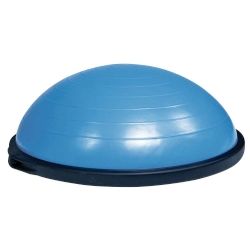
Bosu.  I have the flat side up
  • Hip hikes. Video here.  Balance on one foot barefoot, and "hike" the other hip for one minute while maintaining correct posture (important).  I do for 60 seconds on each side.  Good for stability and glute activation, plus foot strength.
  • Balance on one foot on bosu. Take a bosu, and turn it round side down.  Then balance on one bare foot for one minute while swinging the other leg like you were running.  Again, posture is key.  Addresses the same issues as the hip hikes.
  • Stool dips.  These are a great exercise that target the glutes and quads, but also get the feet and lower legs.  I balance, barefoot, on a 12 inch plyo box.  I then balance on top of the box/pad on one leg, with the other leg held straight and extended in front of the box.  Then, I bend the knee on my standing leg and perform a controlled single leg squat until the heel on the other leg gently touches the ground, then rise back up.  I do 10 of these on each leg, and then a second set with my dangling leg to the side (rather than to the front).  Big point again is to maintain correct posture and not let one hip or the other collapse.
  • Balancing with my eyes closed.  My nemesis.  I've programmed my Garmin to a "workout" of 8 times 25 seconds on, 5 seconds off.  The Garmin vibrates at the end of each 25 or 5 second interval.  So, start the Garmin, and balance on one foot with my eyes closed for 25 seconds.  Then take the 5 second break to open eyes and shift to other foot.  I do these barefoot.  And I stink at them.  But I will master them.
  • Picking up stones with feet   I keep a small tub full of stones near my sofa.  When I get a few minutes free, I empty the stones onto the floor and then pick each up individually with my feet to return to the tub.  The purpose is to strengthen my feet.
  • Towel scrunches  While my breakfast cooks in the microwave, I toss a towel on the floor and scrunch it up under my toes.  Again, feet strength.
  • Toe yoga.  Name for this was coined by my PT.  Push big toe down for 5 seconds while lifting other four toes up.  Then lift big toe up for 5 seconds while pressing other four toes down.  Repeat for 2 minutes.  Added bonus is that you can do these at any time -- those of you with office jobs and closed toe shoes could even do during meetings.
  • Foot band exercises.  This is ankle inversion/eversion, using a theraband (those latex stretchy bands).  First, tie a loop in one end of a theraband, then tie the other end to something.  Now, stick your foot into the loop, so that the band is around the foot roughly half-way between toes and heel.  Move far enough back that there is tension in the band, then slowly first "invert" your foot against resistance (move the inside of your foot more to the inside) for a set of reps, then "evert" your foot (move the outside of your foot more to the outside).  I do 20 reps each of inversion and eversion on each foot, for 80 reps total, on a daily basis. (here's another article explaining).   These work the anterior tibialis, the peroneals longus and brevis, and the posterior tibialis.
  • Eccentric calf dips Video.  These are the gold standard for addressing (or preventing, which is even better) achilles tendonitis.

  • I use a body bar like one of these
    for my anterior tibialis
  • Anterior tibialis lifts.  This strengthens the anterior tibialis muscle on the outside front of the shin.  I take a body bar, and (while standing) place one end on my toes while holding the other end of the bar in my hand.  Then I lift the bar with my toes.  I do sets of 10 reps; weight between 12-15 pounds.

  • Marching glute bridges and side planks with leg lift.  For engagement and strengthening of glutes medius and maximus.  My PT explains them very well, so I'll send you to his write up (go to pages 10 and 12).  I aim for 3 sets of 10 for each daily.

  • Single leg deadlifts  Balance on one nearly straight leg while holding a weight (dumbbell or kettlebell)  in one hand, then lean forward (keeping torso square) while simultaneously lowering the hand with the weight to the floor in front of you and raising your other leg behind you.  Here's a good description.    It's key to keep the movement controlled and your core engaged, with hips level (no twisting or rotating). This forces your core and glutes to work together, and also makes your feet and lower legs work some to stabilize you.  I do these everyday with light weight or no weight at all as an "easy" exercise that challenges balance and coordination.  Increase the weight, and you have a more challenging exercise (see below).

Challenging  As noted above, these are the exercises that are beneficial, but also can tire me and fatigue the same muscles I use when running.  In order to ensure that these DON'T compromise my running workouts, I do these immediately after my hardest running workouts (intervals, tempo, long run).  That way, I have the best chance to recover from them before the next workout  Effective training isn't just about stress, but about the proper balance of stress and recovery; doing squats on an easy day is a good way to compromise your training. 

And of course, since the goal of these is injury prevention, I skip them if I feel that I tweaked something during a workout.  It'd be pretty stupid to get injured doing the very thing that's supposed to keep you healthy.
Ye olde power cage.
  • Barbell squats.  Pretty self explanatory.  Set up power cage, weight up the bar, and squat.  I do in sets of 8 -- if you must know the #s, I start at one set of 8 reps of 115 pounds, and then up the weight by 5-20 pounds for each successive set - usually ending anywhere between 145 and 155.  My goal in doing these is to place weighted stress on my spine to encourage bone density there (I have osteopenia in my spine that's close to osteoporosis levels, so this type of work is really important).  I only squat to barely parallel; since my goal is spine loading, I'd rather get more reps with a more limited range of motion.

  • Good mornings.  Another good one for placing load on the spine.  Video here.  I do for 2-3 sets of 10 reps, usually between 95-115 pounds. 
  • Single leg deadlifts.  Same as above, only I use a heavy weight - up to about 35 pounds if I'm up to it.  This is great for making your glutes medius and maximus coordinate with your core.  I hold the dumbbell in one hand only, which makes me work a little harder to keep balance, since the single weight pulls me to the side.  I'll do this both with the weight in the same hand as the leg I'm balancing on (right hand, right leg) and opposite hand and leg.

  • Quad presses with limited range of motion.  I have a slight tendency towards runners knee, with a very clear cause -- my vastus medialis ("VMO") muscle on the inside of my thigh tends to get weaker than my other quads, with the result that my knee cap gets pulled slightly out of alignment.  Very easy fix -- keep the VMO strong.  So I sit on a leg extension machine and isolate the VMO by working a very small range of motion - just from knee almost straight to knee straight.  If you increase the range of motion by bending the knee more, other muscles get engaged, so it's better to stick to a very narrow range of movement, and pulse the muscle within that range.

Wednesday, March 14, 2012

Getting to the core of it all

In a nutshell, I've been asked a couple times recently about what core exercises I do.  So, why not list them out here.

My routine admittedly varies from the "standard" core routine, in that I don't do crunches.  They're certainly not at all necessary for strength -- when I rode horses I had a ridiculously strong core despite never doing a crunch ever.  [Many people don't realize that much of controlling a horse at the higher levels is done via using your core to manage the distribution of your own weight in the saddle -- it's like planksx100.  Anyone who rides and shows horses regularly has an extremely strong core, plus inner thigh muscles].
 
Nor do I think that crunches are running specific -- the motion doesn't mimic anything we do while running.  Since the ultimate purpose of core work (for runners) is the maintenance of body stability even when you're extremely fatigued, I focus on exercises where I stabilize my core against different forces, be they rotational pull against my torso or movement of arms and legs in different ways.

So, here's my favorites:

  • Planks.  
    • These are a classic, but I like to do them with a special variation -- I place my toes on top of a medicine ball rather than on the ground, so that I have to stabilize my torso against my legs trying to fall to one side or another.  The smaller the ball, the harder this is.
  • Headstand leg lift 
    • I picked this one up when I was playing Capoeira a few years back.  This gets your lower back, and also your glutes and abs.  To do this one, get into headstand position, then lower your feet to the floor, keeping your legs straight, and raise them back into full headstand.   Better explanation here.  It's a similar exercise to back extensions, but targets the back and abs more and the glutes less, doesn't require access to a gym, and is much more fun.  I do these at least once a week.
  • Balance on ball 
    • This is a fun one.   Find an exercise ball (bigger is better here, and an under-inflated ball will make this significantly harder).  Then climb on top of the ball, first balancing on your hands and knees, then on just your knees.  
    • Once you've got that down, practice balancing on the ball on your knees while swinging your arms in a motion that simulates running.
    • When you've got that down, then add in light weights in your hands (5 pounds or less).  This isn't so much a strengthening exercise as a balance and coordination exercise.  Thus you want to keep the weights fairly light: just heavy enough that they disrupt your balance slightly when you swing them, and you have to focus to avoid falling.
    • I like this one because it forces the glutes and abs to work together to stabilize you in the same way they do when running.
    • You can actually integrate this into a solid routine with the following sequence: a) balance on balls and swing weights; b) put the weights down and walk your upper body out, so that you're now in plank position with your feet on the ball; c) do a set of push ups; d) walk your body back in. 
  • Palloff Press
    • Essentially, you use a cable machine with the cable pulley set at the level of your sternum.   The video linked here from Competitor magazine does a great job of explaining it, so I'll just send you there.
  • Side Planks with Leg Lift and Marching Leg Bridge.
    • My PT turned me on to both of these glute activation/core exercises, and I do them daily.  He explains them better than I could, so I'll refer you to his guide (go to pages 10 and 12).
  • Single Leg Deadlifts
    • Basically, you balance on one nearly straight leg, holding a weight in one hand, then lean forward (keeping torso square) while simultaneously lowering the hand with the weight to the floor in front of you and raising your other leg behind you.  Forces your core and glutes to work together, and also makes your feet and lower legs work some to stabilize you. 
    • Here's a good description.  I like to modify by holding a dumbbell in only one hand, which makes me work a little harder to keep balance, since the single weight pulls me to the side.  I'll do this both with the weight in the same hand as the leg I'm balancing on (right hand, right leg) and opposite hand and leg.
  • Classes.  
    • Yup.  Those yoga/pilates/floor barre classes are great for core work/stability, with the added bonus of an instructor to correct those imbalances that you don't notice.  I try to fit in several classes per week.
  • Everything.
    • Seems like a truism, but really ALL exercises are (or should be) core exercises.  When I do my strides and drills, or pull-ups and squats in the gym, I try (as much as I can) to keep my torso properly engaged and active.  Even if that means that I have to lower the weights a bit to ensure that I don't lose form from fatigue.  It's not just about strength, but about the habit of USING that strength.  And every time you're not practicing something correctly, you're practicing it incorrectly.

Wednesday, February 22, 2012

Floor barre

As someone with a history of injury, I'm pretty familiar with cross training.  In the depths of an injury, you tend to focus on cross-training that is a substitute for running - i.e. pool-running, elliptical, instead.

Well, it turns out that ballet dancers have something similar.   It's called "floor barre," and it's essentially ballet maneuvers performed while lying on one's back or side, instead of standing -- practice for ballerinas who can't stand on their feet.  It's plies, first position, second position, etc, all while laying on a mat.

You may have noticed it in my weekly training log -- I first tried this class during a rest week about half a year ago, and fell in love.  While formally aimed at ballet dancers, I believe this class works really well for runners for injury prevention. It targets the traditional runner weak spots of glute engagement and ankle strength and flexibility.  And, since it's focused on alignment and muscle engagement, rather than strength, it works well as a recovery/injury prevention workout.  You can take a class without concern about interfering with recovery from a hard workout, or compromising tomorrow's hard run.

The class starts with a series of simple leg raises and abs while on the floor, as a warm-up, followed by a series of ankle circles and pointing and flexing the feet.  All of this while lying on your back.  The foot exercises are excellent prevention for anyone with a history of foot/ankle tendonitis (raises hand foot).

The above video, starting at 1:50, is a good illustration of the foot/ankle exercises that are part of floor barre (no, thankfully the class I take doesn't impose classical music on us -- I'm not sure I could take the class, were that the case).

From there, it moves on to an ever more challenging series of posture exercises (again, all on the floor), as you attempt to balance on your side on a padded mat while doing different things with arms, legs, and head.    The exercises are not overly challenging from a sheer strength perspective, and don't look all that impressive to an outside observer.  But they are difficult in their own way -- it's impossible to maintain your balance on your side unless you maintain ABSOLUTELY perfect posture, including relaxed but active and engaged glutes and abs.  Lose your engagement for a second, and you roll onto either your rear or your stomach (and laugh a bit).  And much of the work is done while moving one leg in isolation.

Here's an example video of some of the side exercises (some of which are more difficult then what we do in the class I take).

See how that works -- focusing on keeping your abs and glutes engaged and firing correctly while one leg  moves independent of the other?  Makes it obvious how useful this class is for runners, especially those with glutes that like to turn off.

The majority of the class focuses on ballet maneuvers on one's back or side, but there is a 10 minute "intermission" (my term) in the middle where we focus on ab strength, in what most people find to be an extremely challenging ab workout -- certainly more difficult than any special "abs" class or "abs section" in Baptiste-style yoga.  The sequence starts very simply - you breathe in and out, while alternately engaging and relaxing your abs.  Then the sequence progresses, first adding arms, then legs, then rotation, then straight legs, then bicycle motions, and so on.  All while being sure to maintain proper breathing technique and good posture.

Generally, only about 2/3rds of the class completes the abs section, with some of those modifying the workouts in order to complete.  It's not an easy abs workout.  But a strong core is essential for good running, and this abs section, which ignores standard crunches (which are useless) in favor of stabilizing your core while your legs do different things, seems tailor made for runners.

Then it's back to the ballet, doing "plies" while lying on the mat -- great for opening the hips and improving hip rotation, which is a personal bugaboo.  Follow up with some planks and stretching, and you're done.  And a bit closer to being a strong, injury-minimizing runner.

The one problem with floor barre is that it can be pretty difficult to find -- you have to search for a dance studio, rather than a gym or yoga/pilates place.  But it's worth it.  I'm pretty lucky in that my gym, Mint, offers the class as a perk to members on Tuesday evenings (6:30-7:25).  However, this class also open to non-members for a fee (I don't know the exact pricing, but I do know it's competitive with local yoga studios).

If you want to find me on Tuesday night, this is generally where I am.

Wednesday, February 8, 2012

Ode to the Arc-Trainer

So, a few weeks back I had my silly shin tweak.  I refuse to call it an injury, because in my mind, an injury is something that FORCES you to take time off.    A tweak or a niggle is something where you don't NEED to take time off, but choose to do so, so as to avoid injury.

[yes, this distinction is being overly anal, but I do it for a reason.  My big goal for this season is to avoid injury, and I don't want to put myself in a position where I don't back off because I don't want to admit something's wrong.  If I call it a tweak when it starts, instead of denying it I respond immediately and prevent it from evolving into an injury.  See how that works?  You cut back by choice, before you have to.]

So, as I was saying, I tweaked my shin.   And I cut back on my running and skipped my hard workouts for a month.  And when I came back, I had really lost very little fitness.  Pool-running was part of this, but I also give a great deal of credit to my use of the arc-trainer.

***

So what's an arc-trainer?  Well, it looks like a variant of the elliptical, but with even less dignity.  Here's a picture.  It's a bit intimidating at first, but pretty easy to figure out how to get on (step onto the steps; grab the handles).  Then once you get on, you program in time, incline, and resistance, and go on your way (well, so to speak). 


So, it's like an elliptical, but different.  I really don't know how to explain the difference, except to say that the arc-trainer at a low incline (I set on 3) has a motion that is much more like running than the elliptical.  Same path traveled by the feet, same stride length, and same exact action of glutes versus quads.  Below is a promotional marketing video from Cybex that hopefully sets this forth a bit better. 

Particularly interesting is the point made about the excessive stress on the knee from the elliptical (versus the arc-trainer).  From the video, it looks like the elliptical mimics the stride of an inefficient overstriding runner, while the arc-trainer's stride is much closer to correct running form -- thus the greater risk of hurting something while on the elliptical (this is likely why avid runners also cannot STAND the ellliptical).  In my experience, the only real difference between the arc-trainer and the treadmill is that the former is non-impact, and so your calves and shins aren't doing the same work they would be doing while running -- fantastic if you're battling shin or calf issues.


To my mind, this makes the arc-trainer a better substitute for running than pool-running for both easy runs and tempos (more later on why intervals don't work as well).  Pool-running tends to have a slightly different leg motion than land running, and also works the hip flexors far more than the glutes, leading to some imbalances when you return to land.  Additionally, due to the effects of being in the water, pool-running heart-rates tend to be 15-20 beats lower than land, while the heart-rates one can achieve on the arc-trainer are nearly exact to those you hit while running.  In fact, I simply equated arc-trainer miles to running miles by assessing how long I "ran" at a certain HR.  145-150 BPM for me is about 8:15 pace, so 32-33 minutes at that pace was ~ "4 miles"

As long as you're cleared for weight bearing, you can mimic close to the exact running motion by a) setting the incline to low and b) ignoring any handles that may exist and instead stabilizing your torso and swinging your arms as you would while running.  It feels darn close to running (with the added benefit that you get to watch TV).

***


During my "tweak time", I used the arc-trainer to sub for easy runs, tempos, and the second part of long runs -- I just used perceived effort as my guide for how hard to go (upping the resistance to match), and a tempo on the arc-trainer felt nearly EXACTLY like a tempo on the track (and with nearly the same heart rate, to boot).  For long runs, which my coach generally has us do as progressive effort workouts, I would do the first part of the long run by running easy outside for as far as I felt was safe.  Then I'd drive immediately to the gym, hop on one of these, and after a quick warm-up I'd start pushing the effort to mimic the harder work of the final part of the long run.


By following this plan, I was able to keep up with my coach's scheduled workouts almost exactly.  The one workout I DIDN'T use the arc-trainer for was intervals.  For those, I relied on pool-running, simply because I found that the arc-trainer became unstable at the effort level I associate with hard intervals.  Not enough that I thought it was going to flip over, but the machine would definitely start to move across the floor, creating a bit of a hazard.

***


So yeah, 4 weeks of substituting the arc-trainer for easy running and tempo effort, and pool-running for intervals, and I came back fine.  Happy ending.  But... there are two caveats about using the arc-trainer.

1) They can be hard to get access to.  They're expensive and take up a good amount of floor space, so most of the gyms that have them just have a few.  And, they are extremely popular for the silliest of reasons -- basically the calorie count on the machines is ridiculously inflated (supposedly I burn 1200 calories an hour on one of them) and so people desperately trying to match calories in versus calories out flock to them, because they "burn the most calories for the least effort...."  (I leave it to the reader to assess the logic of that statement).

2) Because the arc-trainer is SO good at preserving every aspect of fitness except lower leg strength, there's a real risk that one gets reinjured by coming back to running too quickly.  Your cardiovascular fitness is there, as is the quad and glute strength.  But, if you've spent more than a week or so on one of these things, you've doubtless lost a lot of strength in your lower legs, and you need to carefully and gradually transition from the arc-trainer back to full time running to avoid a new injury (*ahem* tweak).

[Final disclaimer - I own no stock in Cybex, and have never had ANY communication with them regarding this or any other product.  I just like the machine a lot]