Sunday, June 24, 2012

Race report: PVTC track mile, June 24, 2012

I ran a track mile today at the PVTC Track meet, finishing in 5:40.  The time's a bit disappointing, as I previously ran a road mile significantly faster -- the road mile was NOT net downhill and had some hills, so I was expecting a faster time here.  But, didn't happen.

No clear reason why, either.  The weather was perfect for a track race, and I was better rested and felt fresher for this race than I did for the road mile.  In the end, I think it was just an off day. We all have them.  And better for it to happen during a summer race at a distance that's not my focus.


Warmed up with 3 miles easy jog, plus some drills and strides - same as I do before all my workouts.  Only thing different between this race and my previous mile was that I didn't do a "first interval." (in track workouts, the first interval is always the hardest for me, while the second feels better, and the third even better - so sometimes I like to do a "first interval" before the race per Jack Daniels, to get the slow one out of the way).  But I really can't say that that made the difference.

I didn't do anything stupid in the race --I went out at a controlled but honest pace - I wasn't running slow, but I felt well in control.  Then, I just flowed forward a bit more each lap.

For the first lap, I was running in a group, and even got boxed in for 100m or so.  I just waited patiently, as I figured the pack would fall apart very soon.  And it did.  In fact, after the first lap, everyone fell apart and I was on my own, holding my own pace.  I guess it would have bothered others to be running solo - I actually didn't mind that much, as I don't mind leading or running on my own.  So I just flowed and focused on running my own race, which was easier without distractions from others.

My plan was simply to run hard but relaxed, flowing forward a bit more, and then really starting to push at the last 200m.  Stuck to plan, but when I tried to really sprint for home, I just didn't have an extra gear.  I heard people cheering the kids that were sneaking up to me, but all I could do was hang on as the kids passed me in the home stretch.  It wasn't a matter of not wanting it enough - if I could have stuck my hand in an open flame to keep those kids from passing me, I would have.  But that wasn't an option for me.

Oh well. 


Obligatory overanalytical bit:  I wore my HR monitor for this race, as I do for all my races.  And, HR peaked at 179, which is the middle of my tempo heart range.  Same thing happened during my last mile race.  I cannot figure out for the life of me why my HR doesn't go higher in these short races - 5.5 minutes is certainly long enough for it to rise.  I see the same thing in workouts - for some reason my HR always goes much higher in tempos than in interval workouts, and my HR never gets high at all during the first repeat (even though that's the toughest one).  Weird.  And it's not like I'm not tired at the end of these races -- there's no doubt in my mind that I gave what I had to give in the race, HR notwithstanding.

I'm not going to worry about it too much - in the end, I care about my race times, not my race heart rates.  But it is a bit odd.

Other notes:
  • Used a puff of the inhaler an hour before, and another about 20 minutes before
  • Wow, my lungs really hurt after this one.  I may not be able to get my HR up in these shorter races, but the lungs make up for it by getting scalded.
  • Despite my disappointment at today, these races are still a lot of fun, and I'm looking forward to the next.
  • Trying to figure out if I'm getting sick or something.  My throat is scratchy, but there's two logical explanations for this - a) it took me a while to catch my breath after the race, and that may have irritated my throat; b) someone else mentioned that a sore throat was going around, and that may have been enough to trigger my latent hypochondria.  So, I'll just toss back some Zinc, rest, and let it pass.  I don't think it was a factor in the race, though.  I just didn't run fast.

Sunday, June 17, 2012

Training log - Week ending 6/17/12

This week was 71 miles of “real running” and 14 “miles” pool running, plus 2500 yards of swimming breathing drills -- training log is here.

Got a running gait analysis done this week, which I try to get done on a somewhat annual basis. Takeaways were that I’m not horrible, and in particular have a very good cadence. But, I’m still struggling with lordosis in my back (aka "swayback", aka “ghetto bootie”). My lower back arches too much, which means that I end up overstriding slightly, and also hit the ground pretty hard. My back arching also places a lot of stress/compression on my L4-L5 vertebrae and the nerves in that area, which results in periodic sciatica (nothing new about the sciatica – I’ve had it for decades).

fun random fact:
For DC locals who run the "Rock Creek Loop"
- this picture was taken at the stables just north
of Rock Creek Park that we run by.
The lordosis isn’t a strength issue – years of horseback riding have given me a ridiculously strong core. But years of horseback riding also mean years of constantly striving for “Shouders BACK! And stick that butt out behind you!” And that ingrained muscle memory is REALLY hard to overcome. All I can do is keep working at it.

So, my cues to work on are a) POSTURE!, b) leaning ever so slightly forward from the ankles (not hips) to avoid overstriding, and c) trying to land as softly and quietly as I can. These cues make a lot of sense, especially since I know how I get into trouble when I’m running.

When I get tired or want to really pick up the pace, I start to arch my back more . As a result, I start overstriding some, and also hitting the ground harder and harder. So I lose efficiency, and start slowing. And then I get pissed off, and I start trying even harder, which means that I arch my back even more and pound at the ground even harder, and...it’s a vicious cycle. It’s part of why trying NOT to run my hardest works so well for me – because then I’m not working against myself. So, when I start to get a bit fatigued, I’m just using it as a chance to NOT try to work harder, but instead to invoke the cues, and see how they work.

And I’ll be darned if they don’t work pretty well. I focused on them during the second of my cruise interval 3200m repeats on Friday, and….12:21 for 3200m – faster than I normally run those. Played with them again on Sunday for the long run, and ended up running the last 2 miles at about 6:40-ish, while the perceived effort was much less. So, I know what I’m working on this summer.

Dailies  

Monday: In the morning, 50 minutes of easy poolrunning for “5 miles,” followed by 1000 yards of swimming breathing drills and then some light strength training and injury prevention exercises. Foam rolling and stretching in the evening.  

Tuesday: In the morning, 13 miles including a workout of 6 hill repeats – nonstop circuit of up a hill for about 2 minutes, a 90 second easy jog, a stride, and then some more easy jogging to the bottom (whole circuit takes ~5 minutes). Pretty humid, and I didn’t take slow enough recovery on the first, so I ended up with my heart rate peaking into the 200s during each fast part, and “recovering” in the 170s (which is my normal tempo HR). Yup. It hurt a bit. But will make me stronger. Followed with injury prevention work and 20 minutes of easy pool-running. Floor barre and foam rolling at night.  

Wednesday: In the morning, 12 miles easy (8:06 pace) and then a yoga class. Later, did another 4 miles easy (7:39 pace). Got a running gait analysis done in the afternoon (which we’ll count as one more mile). Foam rolling and stretching at night.  

Thursday: In the morning, strength training and injury prevention exercises followed by 1500 yards of swimming and 35 minutes of easy poolrunning for “3.5 miles.” Foam rolling and stretching at night.

Friday: In the morning, 13 miles including a cruise intervals workout of 2x3200m with 800m jog recovery. Splits were 12:48 (6:32/6:16 – very sluggish first 800m, since I ran out of time to do drills) and 12:21 (6:18/6:03). Followed with injury prevention work and 15 minutes of easy pool running. Foam-rolling and gentle pilates in the afternoon.  

Saturday: In the morning, 11.5 miles very easy (8:18 pace) plus some drills. Upper body strengthwork and foam rolling in the afternoon.  

Sunday: 16 miles progression (7:40 pace, split as 8:23 pace for first 7 miles, next 3.5 at 7:30, next 3.5 at 7:05 pace, and last 2 averaging 6:37 pace) followed by injury prevention work, foam rolling, and 20 minutes of recovery pool-running. Flow/restorative yoga tonight.

Thursday, June 14, 2012

"You've got mail"

So, somewhere along the line, I ended up on the mailing list for "Active Schwaggle."  As far as I can tell, it's a social buying site similar to Living Social or Groupon, but targeted at runners and triathletes, and run by active.com (a website that handles registration and results for some of the races that I run).

I got an interesting email the other day. 

Social buying sites are usually used when the seller wants either to promote something or to unload something.  Neither criteria seemingly applies to a very well known marathon that's been sold out for months (and that sold out in a matter of hours).

I was intrigued.  So I clicked to see the deal.

And...


So... you get a "44% discount" off your purchase of a commitment to raise $900 for the "Lazarex Cancer Foundation" by October 19....

I am amused.  First of all, the entire concept of a "Groupon" - a classic example of the modern consumer mindset - for a charity cracks me up.  And then the sucker punch of "Hey!  Save $40 (but only if you raise $900)" is truly awesome.

None of this, BTW, is meant to be an attack against the Lazarex Cancer Foundation, which from a very preliminary glance appears to do good stuff. (note that I have not researched them deeply.  For all I know, they're as deceptive as Komen in terms of how they manage their funds).  And the fact that Lazarex apparently makes its runners pay their own entry fees elevates it above groups like Team in Training, where runners get their entry fees and travel expenses funded.  In essence, TnT runners get their fun marathon trip paid for by their friends.

I can't blame Lasarex for jumping on the social buying bandwagon.  They're just using all the techniques available to them to promote their cause.  And hey, even if only a few people actually sign up, it still is probably worth it to Lasarex.

But still.  I can't help but wonder what comes next...

Sunday, June 10, 2012

Training log - Week ending 6/10/12

This week was 70 miles of “real running” and 14 “miles” pool running, plus 1500 yards of swimming breathing drills -- training log is here.

Just a basic training week, highlighted by blissfully awesome running weather for June. We had a spate of relatively cool temperatures and low humidity, which was fantastic. With the combination of a) no humidity and b) no pollen my lungs felt awesome for the first time in forever. Like winter all over again. I know it’s not going to last, but sure was nice.

I was a bit tempted to hop into a local 10K this weekend – “Lawyers Have Heart” but decided to skip. Lawyers Have Heart was my first race ever, so there’s the obvious appeal of returning “home” to it. On the other hand, my last few weekends have been semi-packed with races and social obligations; it was nice to have a relaxed week. And I got to get some good workouts in, which makes me feel positive about the future (the fall).

Dailies  

Monday: In the morning, 50 minutes of easy poolrunning for “5 miles,” followed by strength training and injury prevention exercises. Foam rolling and stretching in the afternoon.  

Tuesday: In the morning, 13 miles including a track workout – a pyramid of 400, 800, 2x1200, 800, 400, plus two bonus 200’s. Ran 89, 2:55, 4:19, 4:22, 2:49, 79, and then 38 and 38. Followed with injury prevention work and 15 minutes of easy pool-running. Floor barre and foam rolling at night.  

Wednesday: In the morning, 10.5 miles easy (7:50 pace) and then a yoga class. Later, did another 5 miles easy (7:36 pace). Foam rolling and stretching at night.  

Thursday: In the morning, strength training and injury prevention exercises followed by 1500 yards of swimming and 40 minutes of easy poolrunning for “4 miles.” Foam rolling and stretching at night.  

Friday: In the morning, 13 miles including a cruise intervals workout of 2x3200m with 800m jog recovery. Splits were 12:36 (6:25/6:11 - 6:20 pace)) and 12:31 (6:20/6:11 - 6:18 pace). So, nicely consistent. Followed with injury prevention work and 15 minutes of easy pool running. Foam-rolling and gentle pilates in the afternoon.  

Saturday: In the morning, 11.5 miles easy (7:56 pace); upper body strengthwork and foam rolling in the afternoon.  

Sunday: 17 miles progression (7:55 pace, split as 8:54 for first 3 miles, 8:08 for next 7.5, and last 6.5 at 7:15 –  pretty happy with this) followed by injury prevention work, foam rolling, and 20 minutes of recovery pool-running. Flow/restorative yoga tonight.

Wednesday, June 6, 2012

Oh, the irony of it all (plus potassium, too)

This is a plushy red blood cell.
You can buy him here.
We all hear it to some extent - iron levels are critically important to the competitive runner.  To be more specific, red blood cells are critical -- they're our mechanism of oxygen transfer.  And iron is used by the body to create the hemoglobin that the red blood cells use to carry the oxygen. 

I had understood this importance for some time, and I've regularly pestered my primary care doctor for iron testing during my annual physical (to be more specific -- serum ferritin testing, as I understand that's the key metric).  My primary care doctor (a non-runner) thinks I'm a bit crazy for pushing this issue.  In her experience, it's quite rare for well-nourished non-vegetarian adults to have an iron deficiency and more common for them to over-supplement.  Plus, anyone capable of running multiple miles in a row can't possibly be anemic.

As you can probably guess, she doesn't have much experience with competitive runners and the effect iron can have on their running.

So, I've advocated for this test annually, and sometimes gotten it, sometimes not (to explain, my bad circulation makes me a difficult blood draw, and sometimes we have a very limited quantity of blood to analyze, and she'd rather run another test.  Because again, I shouldn't be concerned about iron.)

My perspective has always been that I am a female long distance runner, and so I need to worry about this.  As a dedicated red meat eater - specifically bison, which I eat at least 4 times a week, if not close to daily -  I'm not a huge risk.

I'm also decently educated about nutrition.  I know not to combine iron and calcium, and I know that animal-based sources of iron ("heme") are superior to vegetarian sources ("non-heme") in terms of uptake.  It's not just what you consume, but what your body actually takes in, that matters.  But still, I should be watching this.

The issue was brought to my focus again recently when a) I reread a great entry from Camille Herron's blog and b) my teammate Alison determined that she was significantly deficient.  Hmmm.  A really good idea to stay on top of this -- and to get tested more than once a year.  And, since I just ran a mile PR, why not get it checked now, to see how things look when I'm doing well?

And so, I got my iron tested last week.  I followed Herron's example, and used Healthcheck USA to do it. Easy and cheap (except for the 12 hour fast, which was miserable).

And...here's the results, plus my results from previous years (note how I fearlessly post my medical information on the internetz).  Pretty interesting.  This basically covers the testing I've done for the past 8 years, plus where I was, running-wise, at the time.  A few things stand out to me.

a) my current serum ferritin (my understanding is that this is what you want to check) of 63.  My understanding is that 60 or above is optimal  (also see here, at page 7 - this is a great article that Camille Herron is hosting).  Right now, I'm at 63 and running well, though in the past I've been much higher.

b) there was one point in my life where I was feeling overtrained and sluggish (October 2010).  I *really* wish that I had gotten my serum ferritin tested at that time.  Instead, I only got iron, which is different.  Still, it's striking how low my iron level was at that time - 43, as opposed to other times where it's been 71 or above. 


Soon after that test was taken, I broke my foot and had to abandon all land running.  I had another test done after 5 weeks of non-impact exercise only (meaning no footstrike hemolysis), and...look at that iron level (jumped from 43 to 145).  And also look at how high my serum ferritin is (163!!!).


My hunch (with no documentation, other than this chart) is that iron levels and serum ferritin levels are positively correlated, and so my serum ferritin was also in the basement at that time.  But oh, how I wish I had gotten it checked.

And, lesson learned.  My plan from now on is to check my iron 2-3 times a year.


***

The potassium addendum.

So my, coach had a nutrition counselor in to speak with us on Monday night at Road Runner Sports (just one of the many perks of training with Capital Area Runners).  She covered stuff like iron, which I already had some familiarity with, but also potassium.

Now, I know that potassium is an electrolyte, has an RDA, and is fat soluble (correction -- apparently potassium is excretable through the kidneys) -- this last point means it's possible to OD on it with supplements.  What I didn't realize is that it's apparently also possible to consume too much potassium based on diet alone.

It's not that much coconut water.
Yup, it is.  Especially if you drink a lot of coconut water.  And I might just have a slight coconut water addiction. Add to that the fact that my dietary staples include potatoes, bananas, and guacamole, all of which are potent sources of potassium, and..I decided it was worth checking my potassium.

As it turns out, last week's serum ferritin test also included a CBC (complete blood count) that included a value for potassium.  And...mine was 5.3, with a recommended range of 3.5-5.2.  So slightly high.

Whoops.

But then I went back and parsed through my old tests, and my potassium level has generally been at or over 5 for the last several years, and I've seen 5.3 a few times before.  And the blood work that my doctor does lists a recommended range that tops out at 5.5, not 5.2.  And my doctor has NEVER raised any concerns about my potassium.  False alarm.  Put away the life boats and peel another banana.

So, two lessons here.  1) give a little thought as to whether you might be ODing on certain things just from your natural diet (and maybe cut back on the coconut water slightly); 2) don't go too crazy jumping to conclusions from these tests.  It's good to be a skilled amateur, but remember that your primary care doctor is a pro.

Monday, June 4, 2012

Training log -- Week ending 6/3/2012

This week was 33.5 miles of “real running” and 13 “miles” pool running, plus 3000 yards of swimming breathing drills -- training log is here.

Physical rest week. Whew. Glad that’s over.

Raced a mile on Monday, setting a major PR (report).  I then took 4 days off from running before doing the Race for the Cure 5K for the heck of it on Saturday. Race for the Cure was hilarious (make sure you read race report here).  So glad I did it.

So, what did I do during my days of rest?
  • Took two hot yoga classes (I enjoy them, but I find that they aren’t a good combination with running training – they interfere with recovery too much.  Normal vinyasa flow or restorative yoga is much better when training).
  • Played around with my swimming some. 
  • Got rid of a ton of clutter – like a pile 10 feet x 3 feet x 1.5 feet high.  It was mostly old text books, old power cords for devices I no longer have, and pots and pans I’ve never ever used. I now own one pot, to be used for hard boiling eggs. And that the only one I need. 
  • Got my iron tested, not because I’m worried I have an issue right now (heck, I just PR’d my mile), but because it makes sense to get a base line now. More on this in a post later. 
Dailies  

Monday: In the morning, a 3 mile warm-up plus drills and strides, and then a mile race in 5:31, followed by 4 mile cooldown. 40 minutes of easy poolrunning for “4 miles” in the afternoon.  

Tuesday: In the morning, injury prevention work plus 1750 yards of swimming breathing drills. Floor barre and foam rolling at night.  

Wednesday: In the morning, nothing (except major home decluttering and getting my iron checked). Later, foam rolling and stretching; hot yoga class at night.  

Thursday: In the morning, 45 minutes of easy poolrunning for “4.5 miles,” followed by strength training and injury prevention exercises. Also some foam rolling and stretching.  

Friday: In the morning, 1250 yards of swimming breathing drills plus 15 minutes of easy pool-running. Followed with injury prevention work. Foam-rolling and stretching in the afternoon.  

Saturday: In the morning, 11.5 miles, including a 5K "race" in 19:42. Later, did 15 minutes recovery pool-running.

Sunday: 14 miles progression (7:42 pace, split as 8:19 for first 3 miles, 7:50 for next 4, 7:23 for next 5, and final 2 at 6:53) followed by injury prevention work, foam rolling, and 15 minutes of recovery pool-running. Hot yoga in the afternoon.

Sunday, June 3, 2012

Race Report: Race for the Cure 5K, June 2, 2012

I ran the Race for the Cure 5K in downtown DC this morning, finishing the "course" in 19:42.  It is hopefully the closest in my running career I'll ever get to being in a zombie uprising.

But more on that later.

***

I've always been a bit conflicted about running this race.  On the one hand, I really don't like the Komen foundation.  On the other hand, it's not like this is the "Race to End Emancipation" or similar -- I don't have deep down fundamental objections to the underlying cause that would force me to skip (well, other than the fact that I hate the color pink).  And opportunities to race on the National Mall of DC are few -- other than this race, it's limited to Army 10 Miler, Cherry Blossom 10 Miler, RnR National Marathon, and Marine Corps Marathon.

So I registered, and decided that I'd run only if the weather was remarkably good for DC in early June.  And as it turned out, it was.  62 degrees, low dewpoint, and bright sunshine.  Not optimal conditions for a 5K, but as good as we were going to get.  Game on.

From the start, I wasn't planning on running this as an all out goal race.  I raced on Monday, and haven't run since  -- I took a few days of non-running as a "sabbatical" to top off my "recovery month" of May.  But a reasonably hard run through downtown DC on a nice morning was sounding like a lot of fun and the opportunity to practice running my races relaxed and focused, without any expectations or pressures.

***

And that was how I found myself jogging the two miles from my home to the race start (another reason I love races on the Mall - so convenient).  Jogged another mile to the race finish to use the blissfully pristine portapotties there (rather than fight the crowds at the start), and then a mile back to the start.

I did a few drills and strides in the very limited space available, and then lined up.  After a moment's debate, I opted to line myself up in the immense "5 minute" section of the starting area.  No, I had no illusions about running this race at 5:xx pace this morning.  But the alternative was to place myself way back in the field, while the 5 minute section packed up with walkers, cross-fitters, and a surprisingly large number of people with their bibs attached to their backsides.

A few promotional statements, and then the race started (5 minutes late).  I started pretty slowly, both to dodge traffic and because that was what felt right.  I was feeling a bit sluggish and slow at first (I'm guessing because I hadn't run since Monday), and so it took me a while to find my rhythm.  So I stayed easy, even though that meant running behind the girl wearing a pink tutu and the guy in black compression tights (seriously?  black compression tights in June?  This is the second year I've seen this at this race).

I wasn't too worried, as I wasn't really racing this, but just using as an opportunity to practice staying focused and relaxed for the entire race, which I could do at even a slower than normal pace.  But still, it felt good when my legs finally woke up and I felt like myself again.  I started to flow, and passed black compression tights guy and tutu girl.

And then the fun really started.

***

Though I didn't have the course memorized, I had some basic familiarity.  I knew it took a right turn to cut south across the Mall soon after we ran back past the start area, and then a left at one of the "inside" Mall streets to head east.  Then later, another right to go south a bit more, before a final left to finish on Independence.


So it was the most natural thing to make the right turn onto 14th street when I thought I saw someone waving us that way.  I was running in my standard way - focusing on the road ahead about 20-50 meters ahead of me, while looking more forward from time to time.

And the next time I looked forward, there was NO ONE ahead of me.  Huh?

Took another glance forward.  Nope.  No one.

I paused a second and looked back.  (Yes, I know you never look back in a race, but this was a special circumstance).  A group of people behind me, and nobody screaming at me that I'm off course.  Not knowing what to do, I just kept running.

And then I looked forward and saw that the course ahead of me was NOT closed.  More specifically, a large group of pedestrians (hordes of tourists) were crossing 14th.  A continuous river of them, about 5 people deep, with no breaks to dodge through.  Oh FFS... 

Not knowing what to do, I went to my default -- when in doubt, go FORWARD.  And I plunged through the tourist wall, arms instinctively shifting to mosh pit position (hands in by upper chest, elbows down and slightly out).

And on the back side I realized what the combination of no lead pack and a tourist crossing meant.  "Shit - I'm off course."  Took another look back and other racers were behind me, following me in my errant ways (and widening the hole I had started).

I had single-handedly taken a large group of runners onto the wrong course.  In the largest and most visible 5K in DC.  Not only had I eliminated myself, I had just ruined a lot of other people's races too.  This was Hot Chocolate all over again.  Except this time, it was all my fault.  What to do?

I kept running.

My whole goal was to run something a bit over 3 miles in distance at a decently hard effort while maintaining race focus and staying relaxed.  So, I might be DQ'd, but I could still achieve my goal for the morning.  As for those behind me, no way I could turn them around even if I stopped.  So I kept on.

Up the incline of 14th Street, debating where to turn.  Jefferson Street?  That had a cone.  Might as well turn there.  So I did.

And faced the surreal -- an utterly empty downtown DC street.   This road WAS closed.  No cars, no lead pack of runners, no runners at all.  Just a long stretch of pavement.

I took another look back - the rest of the "race" was behind me, but I was building a decent lead.  I was all alone.    I've always found it easier to run when I'm NOT in a pack and have some space, but this was ridiculous.


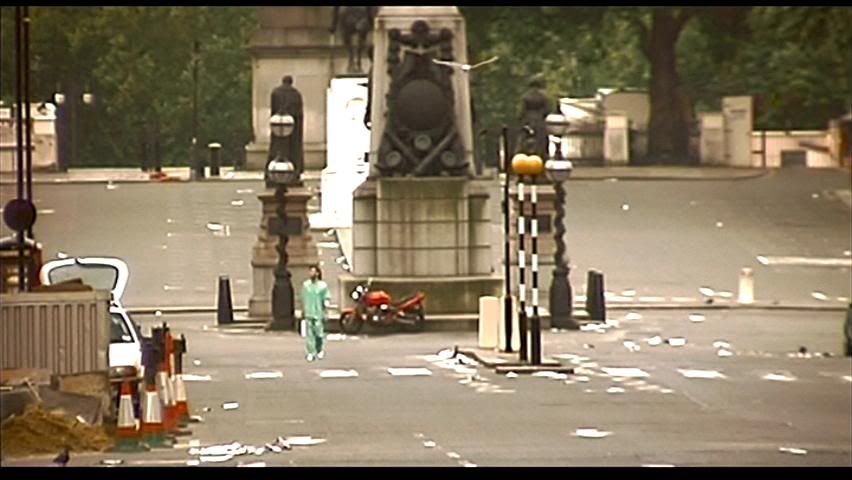
Yeah.  Like this.  Except I was moving a bit faster.
(scene from 28 days later)

And no mile markers to be seen either.

Again, a brief flicker of a question - what to do?  And then my instincts and my analytic side agreed - keep running!    I was no longer participating in the race in any sense of the word, but you're always supposed to "run your own race" anyway, and this was just the reductio ad absurdum of that basic tenet.

And so I ran onward, focusing on my own effort just as I would have normally.   Some tourists were walking on the sidewalk, and they started cheering madly for the woman leading the entire race (I looked back and saw a large mass of runners trailing into the distance).  Um no, not really.

But at least I was in the lead. One thing common to real races, faux races, and the zombie apocalypse -- it's always best to be running faster than everyone else.

From the upcoming Brad Pitt movie World War Z


But then, another question.  Where to turn to get to Independence and the finish line?  I debated turning right on 9th, but that looked very narrow.  Nope, not a good choice.  There was another cross street a bit further.

7th Street?  Sure, that sounded good.  I knew the finish line was by the Air and Space Museum, and that was at the corner of 7th, so I probably needed to turn there to make sure I didn't pass the finish.

So, right turn onto 7th, and suddenly there were other runners again.  I rejoined the race flow, and just focused on finishing the race strong but relaxed.  Crossed the finish line, stopped my watch, and immediately started commiserating with other runners, who confirmed that they had run a different course, taking a later turn.  I found a few of the people closest behind me, apologized for leading them down the wrong course, and then went to locate a race official to let them know that I ran the wrong course and needed to be DQ'd.  Then I jogged home.


***

So, I got home, and pulled up the race course.  And then I downloaded my Garmin record of my run for comparison purposes.  And...I had actually run the correct course; it was everyone ahead of me who had run the wrong course.


I emailed race management, correcting my early statement that I had been off course.  I noted that it looked like everyone ahead of me had been off course, but also that I really didn't want everyone ahead of me disqualified.  I suggested that perhaps it would be fairest to treat as two separate races (in truth, I think my "pack" ran a slightly longer course, plus we didn't get to run head to head against each other for most of the course.).  But the verdict was that that wasn't really doable as there was no way to determine who ran which course.  Fair enough.  I didn't really care that much.

I got a good workout on a beautiful day in a beautiful city, which was what I really came for. The great story was just a fantastic bonus.

Other notes:

  • Left house at 7:15, which was just about perfect timing.
  • There was no real room to do drills and strides (they had a small area, but not really long enough).  I think this, combined with the fact that I hadn't run since Monday, explained why it took me so long to hit my pace groove.  If I ever do this as a "race race," I'll allow more time so I can jog off somewhere and get properly warmed up.
  • Two puffs of inhaler at 7:00 am; two more at 7:40.
  • Splits were 6:32 for the first mile (10M race pace - yup, started slow) and then 13:10 for next 2.11 (6:15 pace).
  • Ended up "4th female" overall and the "age group winner" (quotations because, again, we didn't all run the same race and weren't competing against each other).
  • Yes, I own pink compression socks.  No, I didn't wear them.

Monday, May 28, 2012

Race report: Loudoun Street Mile, May 28, 2012

I ran the Loudoun Street Mile today -- my first road mile ever -- finishing in a time of 5:30.6 5:31.5 (they do decimals for these things and also later adjusted the results).  That was good enough for 16th overall and 2nd in my age group.  It was also a 18 second PR over my track mile PR from last summer (which is, in fairness, the only mile I had ever raced before today).  So yay.

My plan this summer, as I've noted before, is to race the mile or shorter a lot.  It's great for developing a comfort with running very fast and also a way to race without compromising one's training too much, as it requires very little taper or recovery.  Additionally, the oppressive heat and humidity of a DC summer really isn't much of a factor for a race that lasts six minutes or less.

A few weeks back, I had been browsing the race listings, and I noted a cool-looking road mile out in Winchester, Virginia (about 90 minutes from DC).  It looked like a lot of fun, but as someone who doesn't specialize in this distance, I really couldn't justify three hours total of driving for the race.

And then some friends who lived not too far from Winchester invited us to drive out and visit on the afternoon/early evening of the 26th (Saturday).  Well, Saturday was booked, but....hey!  We could go on Sunday, visit them, then stay over the night in Winchester (saving us a late night drive back to DC) and I could race the mile in the morning.  Brian was on board, and a Sunday visit worked for our friends, and the plan was set.

***

So, we drove out to Winchester on Sunday (stopping on the way to give my horse a bath), checked in and showered at the hotel, then headed off to visit our friends.  Dinner was fun, punctuated by a cute offer by our (non-running) hosts to provide a special meal so I could carb load for my race...  I explained that this wasn't that type of race, and that steak was actually perfect.

[for the record, steak's pretty much perfect anytime]

We did stay out a bit past my bed time, but I wasn't terribly concerned -- the race wasn't until 9 am, and since it was just a fun thing for me, I wasn't too worried.

Then rolled out of bed in the morning, and did a leisurely jog to the start line (about 1200m from my hotel).  And, since it was a mile race, I could also jog the entire course back and forth, and then some, for my warm-up.  So I did, noting the elevation profile of the course.  My coach had told us to be patient the first quarter mile, and then "let her rip".  But when I jogged the course, I noted that the course had a decent uphill in the second quarter mile.  So, I decided that patience was a virtue that could be extended, and that I'd avoid the temptation to attack the hill with everything I had, saving it for the end.

That was part of my plan.  But the main plan was just to stay as relaxed as I could, run tall, and see what happened.

Jogged, did an extended set of drills and many stride plus one 400m repeat equivalent (done about 10 minutes before the race - my rationale was that since my first workout repeat always sucks, I might as well get it done before the race) and said hi to my teammates.  And then we lined up, with the vibe much different and more intense than the longer races I've done.  Seconds count a LOT in a mile race, and no one was losing even one at the start line.  And the gun went off.

 ***

In retrospect, I've decided that a mile race, especially a road mile, is the closest that running comes to a rollercoaster. There's this sheer sense of tenseness/readyness at the start of a mile race that is so entirely different from any other race.  It's very much like the silence right before a rollercoaster tips over the peak of the first descent.  Then all of the sudden, the gun goes, and everything's in motion, and there's no thought at all.  You just fly.  And you're shocked at how quickly the race is over.  Just gunshot....WHEE!...Finish!

I really didn't notice much during the race -- there wasn't much time.  I did note that I was pretty far in the back during the first minute of the race, and then there was carnage as people started slowing on each side.  The same thing happened on the back side of the hill on the second quartermile.  As with everything in such a short race, the fades were very sudden.  No..."I think she's coming back to me," just someone who was ahead, and then suddenly behind.

One fun feature of the race was that they had quartermile markers, with a person calling splits at each one.  I generally ignore splits and just run by feel, but here I listened to them with a bit of fascination.  Here they are, and my reactions:

First quarter: 82 -OK.  I've heard this before, during some of my 400m repeats. Nothing to note here.

Second quarter: 2:48 - Also familiar - this is about as fast as I usually can run an 800m during practice.  Cool. This number is familiar territory, and I'm still feeling pretty in control.

Third quarter: 4:09 - I have NEVER HEARD this number before.  I have no idea how fast or slow this is, it's just foreign.  Oh hey - there's the finish line.  Just RELAX and don't stare at it.

(I was pretty good at the last bit.  I did tighten up a bit at the very end of the race, but I think that's normal for a mile race)

And that was all I pretty much had time to think.  The race went so quickly that even as I was idly processing the fact that I had just passed one marker, I was approaching the next.  Very different from my experience in longer races where it's at least 6 minutes between each marker. 

***

So splits ended up being:

1:22 (very slight downhill)
1:26 (decent uphill)
1:21 (decent downhill)
1:21 (very slight uphill, plus some slightly rough footing -- the last bit of the race was in a pedestrian mall, so the footing shifted from asphalt to bricks and stone).

And as was my experience with the one other mile race I've done, this was really not very painful.  Oh sure, my lungs felt like they were on fire and my legs couldn't go any faster, but that's been true of many of my longer races too (and the lungs on fire happens during workouts in this humidity also, alas).  But this time, when that happened, I only had about 30-40 seconds left in the race, instead of another mile or two.  Like ripping a band-aid off.  Easy.  When can we do it again?

***

Other notes:
  • Used inhaler twice an hour before, and twice 20 minutes before race.  Needed it once more after.  My lungs feel like someone took a blow torch to them.  But it was worth it.
  • Temperature of 75, DP of 70, and sunny.  But not a factor during the race at all (except for the sunburn). 
  • This was really fun.  A+ would do again.
  • Started a bit behind the start line, as the field was pretty stacked, and I had no business being further up.  But, since it was not chip-timed, part of me wonders if I actually broke 5:30...one can dream, I guess.  Or just race again, that's more fun.

Training log - week ending 5/27/12

This week was 49 miles of “real running” and “15 miles” pool running, plus 2250 yards of swimming breathing drills -- training log is here.

So, my “break month” is almost to an end. The last 3 weeks have been a mental break – I’ve been doing workouts and runs, but deliberately trying not to dig deep for them, and also not to show up for anything I didn’t want to do.

Of course, since I really like training, I ended up making it to every single workout anyway. So now I’m mentally refreshed, and ready to go. But since I didn’t take a slew of non-running days during my mental break (didn’t want to, and the point was to do whatever I wanted), I’m now thinking I should force myself to take a few.

So that’s my plan for this week. I’ll race a mile on Monday for fun (race report to come), and then take the rest of the week as no-running (or as close to it as I can muster) before doing Race for the Cure on Saturday as a fun run. Then an easy run on Sunday, and back into “normal” training on Monday (first week of June).

Other thing of note for the week was my bout of food poisoning on Tuesday night. In a nutshell, this is the second time I’ve made dinner using clams from a can, and the second time I’ve gotten sick about 6 hours after. I’m NEVER eating canned clams again. In fact, I don’t think I’m ever eating shellfish again.

Funny thing was, it cleared pretty quickly. I had every intention of taking Wednesday off, but ended up feeling good enough to run anyway. Only lingering effect was some nausea and heartburn that lasted into the weekend. But no, never eating clams again.

Dailies  

Monday: In the morning, 70 minutes of easy poolrunning for “7 miles,” and then weight lifting and injury prevention work (also some quick foam-rolling). Foam rolling and stretching at night.

Tuesday: In the morning, 12 miles, including a track workout of two sets of 1600m, 800m; followed by 4x200m. Splits were 6:01, 2:57, 5:57, 2:48, and then the 200's in 37, 38, 39, 37. Followed with injury prevention work and then 20 minutes of shake out pool-running for “2 miles.” Floor barre and foam rolling at night.  

Wednesday: In the morning, 10.5 miles easy (8:10 pace) followed by a yoga class. Later, 3.5 miles easy (7:49 pace). Foam rolling and stretching at night.  

Thursday: In the morning, strength training and injury prevention exercises, followed by 1000 yards of swimming breathing drills and 45 minutes of easy poolrunning for “4.5 miles.” Foam rolling and stretching at night.

Friday: In the morning, 11.5 miles, including a 5K tempo in 20:06 (6:36, 6:27, 6:21, and 42 for final bit - 6:29 pace). Followed with injury prevention work and 20 minutes of shakeout pool-running. Pilates plus foam-rolling and stretching at night.  

Saturday: In the morning, 11.5 miles aerobic (7:50 pace average, but I can’t call easy, simply because we got too dehydrated) plus some drills pre-run. Foam rolling in the afternoon, plus an ice bath.  

Sunday: 1250 yards of swimming breathing drills plus injury prevention work.  Foam rolling and stretching in the afternoon.

Thursday, May 24, 2012

Injury Prevention Work

In my weekly training log, I'll often reference injury prevention exercises.  Ever wondered what those were?  Here they are.

Keep in mind that this is my routine, to address my weaknesses (ankle and foot weakness, glutes that don't fire, a tendency for runners' knee, and poor bone density in my spine).  Everyone's different, with their own areas to target, so these may not work for you.

I split my injury prevention exercises into two categories - "challenging" and "easy".  The "easy" ones are those that don't take much out of me, and that I can do every day without fearing that I'm compromising my recovery or taper for my next race.  (and I do try to do them daily)

The "challenging" ones are more physically demanding -- I always do these immediately after my hard running workouts, as the final part of the workout.  That way, I have the maximum time to recover before my next hard running workout (and running IS the priority).


Easy  I shoot for doing these daily, or at least 5 times a week. They don't drain me, so the only reason not to do them is time.  And I've decided that the time spent doing these regularly is more beneficial to my overall running progression than an extra 5-10 easy miles a week.  First rule of improving in running - don't get injured.
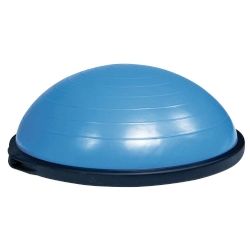
Bosu.  I have the flat side up
  • Hip hikes. Video here.  Balance on one foot barefoot, and "hike" the other hip for one minute while maintaining correct posture (important).  I do for 60 seconds on each side.  Good for stability and glute activation, plus foot strength.
  • Balance on one foot on bosu. Take a bosu, and turn it round side down.  Then balance on one bare foot for one minute while swinging the other leg like you were running.  Again, posture is key.  Addresses the same issues as the hip hikes.
  • Stool dips.  These are a great exercise that target the glutes and quads, but also get the feet and lower legs.  I balance, barefoot, on a 12 inch plyo box.  I then balance on top of the box/pad on one leg, with the other leg held straight and extended in front of the box.  Then, I bend the knee on my standing leg and perform a controlled single leg squat until the heel on the other leg gently touches the ground, then rise back up.  I do 10 of these on each leg, and then a second set with my dangling leg to the side (rather than to the front).  Big point again is to maintain correct posture and not let one hip or the other collapse.
  • Balancing with my eyes closed.  My nemesis.  I've programmed my Garmin to a "workout" of 8 times 25 seconds on, 5 seconds off.  The Garmin vibrates at the end of each 25 or 5 second interval.  So, start the Garmin, and balance on one foot with my eyes closed for 25 seconds.  Then take the 5 second break to open eyes and shift to other foot.  I do these barefoot.  And I stink at them.  But I will master them.
  • Picking up stones with feet   I keep a small tub full of stones near my sofa.  When I get a few minutes free, I empty the stones onto the floor and then pick each up individually with my feet to return to the tub.  The purpose is to strengthen my feet.
  • Towel scrunches  While my breakfast cooks in the microwave, I toss a towel on the floor and scrunch it up under my toes.  Again, feet strength.
  • Toe yoga.  Name for this was coined by my PT.  Push big toe down for 5 seconds while lifting other four toes up.  Then lift big toe up for 5 seconds while pressing other four toes down.  Repeat for 2 minutes.  Added bonus is that you can do these at any time -- those of you with office jobs and closed toe shoes could even do during meetings.
  • Foot band exercises.  This is ankle inversion/eversion, using a theraband (those latex stretchy bands).  First, tie a loop in one end of a theraband, then tie the other end to something.  Now, stick your foot into the loop, so that the band is around the foot roughly half-way between toes and heel.  Move far enough back that there is tension in the band, then slowly first "invert" your foot against resistance (move the inside of your foot more to the inside) for a set of reps, then "evert" your foot (move the outside of your foot more to the outside).  I do 20 reps each of inversion and eversion on each foot, for 80 reps total, on a daily basis. (here's another article explaining).   These work the anterior tibialis, the peroneals longus and brevis, and the posterior tibialis.
  • Eccentric calf dips Video.  These are the gold standard for addressing (or preventing, which is even better) achilles tendonitis.

  • I use a body bar like one of these
    for my anterior tibialis
  • Anterior tibialis lifts.  This strengthens the anterior tibialis muscle on the outside front of the shin.  I take a body bar, and (while standing) place one end on my toes while holding the other end of the bar in my hand.  Then I lift the bar with my toes.  I do sets of 10 reps; weight between 12-15 pounds.

  • Marching glute bridges and side planks with leg lift.  For engagement and strengthening of glutes medius and maximus.  My PT explains them very well, so I'll send you to his write up (go to pages 10 and 12).  I aim for 3 sets of 10 for each daily.

  • Single leg deadlifts  Balance on one nearly straight leg while holding a weight (dumbbell or kettlebell)  in one hand, then lean forward (keeping torso square) while simultaneously lowering the hand with the weight to the floor in front of you and raising your other leg behind you.  Here's a good description.    It's key to keep the movement controlled and your core engaged, with hips level (no twisting or rotating). This forces your core and glutes to work together, and also makes your feet and lower legs work some to stabilize you.  I do these everyday with light weight or no weight at all as an "easy" exercise that challenges balance and coordination.  Increase the weight, and you have a more challenging exercise (see below).

Challenging  As noted above, these are the exercises that are beneficial, but also can tire me and fatigue the same muscles I use when running.  In order to ensure that these DON'T compromise my running workouts, I do these immediately after my hardest running workouts (intervals, tempo, long run).  That way, I have the best chance to recover from them before the next workout  Effective training isn't just about stress, but about the proper balance of stress and recovery; doing squats on an easy day is a good way to compromise your training. 

And of course, since the goal of these is injury prevention, I skip them if I feel that I tweaked something during a workout.  It'd be pretty stupid to get injured doing the very thing that's supposed to keep you healthy.
Ye olde power cage.
  • Barbell squats.  Pretty self explanatory.  Set up power cage, weight up the bar, and squat.  I do in sets of 8 -- if you must know the #s, I start at one set of 8 reps of 115 pounds, and then up the weight by 5-20 pounds for each successive set - usually ending anywhere between 145 and 155.  My goal in doing these is to place weighted stress on my spine to encourage bone density there (I have osteopenia in my spine that's close to osteoporosis levels, so this type of work is really important).  I only squat to barely parallel; since my goal is spine loading, I'd rather get more reps with a more limited range of motion.

  • Good mornings.  Another good one for placing load on the spine.  Video here.  I do for 2-3 sets of 10 reps, usually between 95-115 pounds. 
  • Single leg deadlifts.  Same as above, only I use a heavy weight - up to about 35 pounds if I'm up to it.  This is great for making your glutes medius and maximus coordinate with your core.  I hold the dumbbell in one hand only, which makes me work a little harder to keep balance, since the single weight pulls me to the side.  I'll do this both with the weight in the same hand as the leg I'm balancing on (right hand, right leg) and opposite hand and leg.

  • Quad presses with limited range of motion.  I have a slight tendency towards runners knee, with a very clear cause -- my vastus medialis ("VMO") muscle on the inside of my thigh tends to get weaker than my other quads, with the result that my knee cap gets pulled slightly out of alignment.  Very easy fix -- keep the VMO strong.  So I sit on a leg extension machine and isolate the VMO by working a very small range of motion - just from knee almost straight to knee straight.  If you increase the range of motion by bending the knee more, other muscles get engaged, so it's better to stick to a very narrow range of movement, and pulse the muscle within that range.